
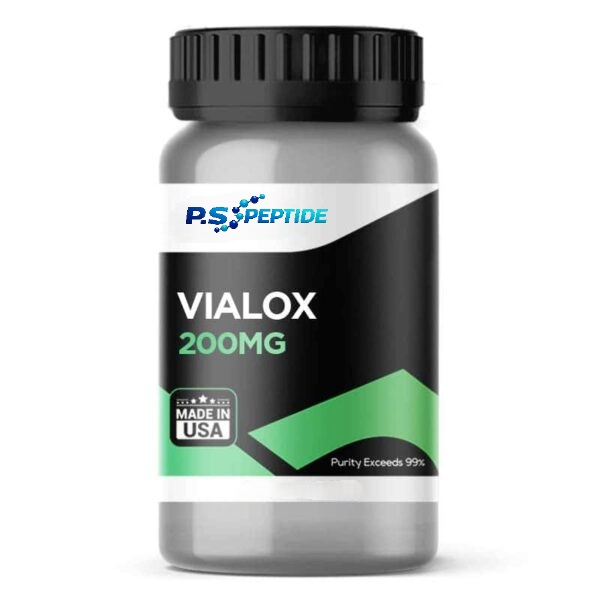
Vialox (Pentapeptide-3V) (200mg)
$175.00
$176.00
Size: 200mg
Contents: Vialox (Pentapeptide-3V)
Form: Lyophilized powder
Purity: >99%
FREE Shipping on $200+ orders
| Title | Range | Discount |
|---|---|---|
| 10% Off | 3 - 6 | 10% |
| 15% Off | 7 + | 15% |
Description
Vialox Peptide: Mechanism, Research, and Anti-Wrinkle Potential
Vialox, also known as pentapeptide-3, is a synthetic peptide with the amino acid sequence GPRPA. Researchers suggest that this peptide may reduce muscle contraction by blocking neuronal nicotinic acetylcholine receptors located on the postsynaptic membrane of muscle cells. These receptors normally transmit signals from nerve cells to muscles, triggering contraction.
By potentially limiting acetylcholine activity, Vialox may help relax facial muscles. As a result, it may reduce wrinkle depth and slow the formation of expression lines along the skin surface. Notably, researchers often compare its proposed mechanism to tubocurarine, a natural alkaloid recognized for its muscle-relaxing properties.
Chemical Composition of Vialox Peptide
-
Molecular Formula: C₂₁H₃₇N₉O₅
-
Molecular Weight: 495.58 g/mol
-
Also Known As: Pentapeptide-3V, SCHEMBL1552457, HY-P0099, ZINC35922739
Research and Clinical Insights
Vialox Peptide Mechanism of Action
Research classifies Vialox as a synthetic peptide that may inhibit neurotransmitter activity. More specifically, studies suggest it behaves as a non-depolarizing neuromuscular blocker, similar to tubocurarine. Tubocurarine blocks acetylcholine at the neuromuscular junction, preventing muscle contraction and inducing relaxation.
Likewise, Vialox appears to bind competitively to acetylcholine receptors on the postsynaptic membrane of muscle cells. Consequently, it may prevent acetylcholine from activating sodium ion channels, which are normally responsible for depolarization and muscle contraction.
Because neuronal nicotinic acetylcholine receptors regulate communication between motor nerves and muscles, blocking these receptors may keep muscles in a relaxed state. Therefore, Vialox may help minimize repetitive muscle movement that contributes to wrinkle formation.
Vialox Peptide and Wrinkle Development
Researchers have investigated Vialox for its potential to soften wrinkles and improve skin texture. While some wrinkle-relaxing compounds raise concerns when used at high concentrations or for extended periods, Vialox appears to have a short half-life and may be introduced less invasively.
Importantly, studies report that Vialox significantly reduced muscle contraction shortly after application. In one test, researchers observed a 71% reduction in muscle contractions within one minute, followed by a 58% reduction after two hours. As a result, decreased muscle activity may lead to visibly shallower expression lines.
Vialox Peptide and Skin Texture Improvement
In longer-term observations, consistent use of Vialox showed promising effects on skin appearance. Research indicates a 49% reduction in wrinkle size and a 47% decrease in skin roughness after 28 days of regular application. Therefore, by limiting muscle movement and smoothing the skin surface, Vialox may support a more refined and youthful skin texture.
Please review and adhere to our Terms and Conditions before ordering.
References:
- Husein el Hadmed, H., & Castillo, R. F. (2016). Cosmeceuticals: peptides, proteins, and growth factors. Journal of cosmetic dermatology, 15(4), 514-519.
- Lupo, M. P., & Cole, A. L. (2007). Cosmeceutical peptides. Dermatologic therapy, 20(5), 343-349.
- Gorouhi, F., & Maibach, H. I. (2009). Role of peptides in preventing or treating aged skin. International journal of cosmetic science, 31(5), 327-345.
- Satriyasa B. K. (2019). Botulinum toxin (Botox) A for reducing the appearance of facial wrinkles: a literature review of clinical use and pharmacological aspect. Clinical, cosmetic and investigational dermatology, 12, 223–228. https://doi.org/10.2147/CCID.S202919
Reviews
There are no reviews yet.