
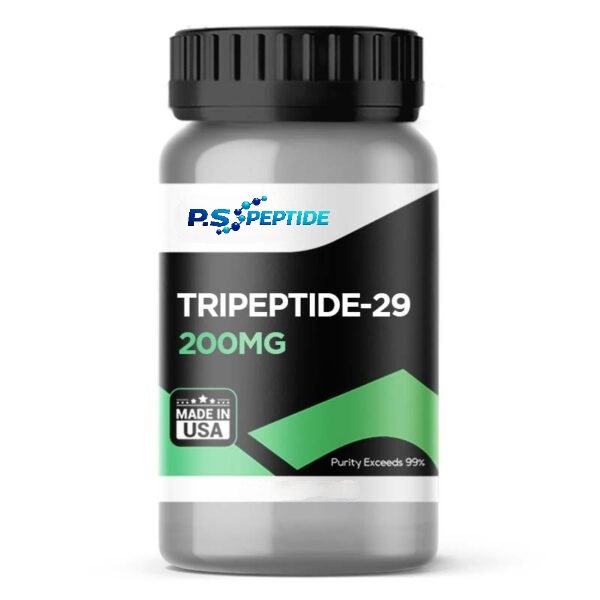
Tripeptide-29 (200mg)
$175.00
Size: 200mg
Contents: Tripeptide-29
Form: Lyophilized powder
Purity: >99%
FREE Shipping on $200+ orders
| Title | Range | Discount |
|---|---|---|
| 10% Off | 3 - 6 | 10% |
| 15% Off | 7 + | 15% |
Description
Tripeptide-29: Collagen Stability, Antioxidant Support, and Cellular Protection
What is Tripeptide-29?
Tripeptide-29 is a small, naturally occurring amino-acid peptide and a fundamental building block of collagen, the primary structural protein in connective tissues. Collagen forms the backbone of the extracellular matrix (ECM), which provides strength, elasticity, and support to cells and tissues.
Researchers suggest that Tripeptide-29 may stimulate collagen synthesis and promote collagen fiber formation. In addition, studies indicate it may exhibit antioxidant, anti-inflammatory, anti-fibrotic, and anti-melanogenic properties, potentially supporting tissue integrity and cellular health.
Chemical Makeup
-
Molecular Formula: C12H19N3O5
-
Molecular Weight: 285.3 g/mol
-
Other Names: Glycylprolylhydroxyproline
Tripeptide-29 and Collagen Integrity
Tripeptide-29 appears to play a key role in maintaining type I collagen stability. Studies suggest that the hydroxyl (OH) group of hydroxyproline contributes to favorable molecular interactions that strengthen collagen microfibrils. As a result, Tripeptide-29 may enhance the durability and resilience of collagen structures.
Furthermore, research indicates that collagen sequences containing Tripeptide-29 experience reduced UV-induced degradation and a slower breakdown rate when exposed to intense radiation. This finding suggests a protective role against environmental stressors that accelerate collagen damage.
In studies using dermal fibroblasts, hydrolyzed type I collagen—rich in Tripeptide-29—demonstrated a capacity to reduce oxidative stress. Notably, Tripeptide-29 emerged as the predominant tripeptide following collagen hydrolysis. The results showed:
-
Reduced formation of advanced glycation end products (AGEs)
-
Lower levels of reactive oxygen species (ROS)
-
Decreased production of denatured collagen
-
Inhibition of matrix metalloproteinases (MMPs)
-
Increased collagen type I expression
Together, these effects suggest that Tripeptide-29 may delay cellular aging by preserving collagen integrity and limiting ECM degradation. Additionally, its small molecular size may enhance skin penetration and bioavailability.
Tripeptide-29 and Glucose Regulation
Research indicates that Tripeptide-29 may act as a moderate inhibitor of dipeptidyl peptidase-IV (DPP-IV). Specifically, the peptide appears to resist hydrolysis by DPP-IV, suggesting stability in the presence of this enzyme. Scientists propose that the Gly-Pro-Hyp sequence contributes significantly to DPP-IV inhibition observed in collagen hydrolysates.
DPP-IV plays a central role in glucose metabolism by degrading hormones such as GLP-1, GIP, and PYY, which regulate insulin secretion, appetite, and blood glucose levels. By inhibiting DPP-IV, Tripeptide-29 may help prolong the activity of these hormones, potentially supporting glucose homeostasis and metabolic balance.
Tripeptide-29 and Platelet Aggregation
Collagen-derived peptides containing the Gly-Pro-Hyp motif may interact with glycoprotein VI (GPVI), a platelet receptor essential for blood clot formation. GPVI activation triggers platelet aggregation, a critical step in preventing excessive bleeding.
Studies suggest that non-cross-linked Tripeptide-29 can activate GPVI by inducing phosphorylation of Syk kinase and PLCγ2 in platelets. Consequently, Tripeptide-29 may stimulate platelet aggregation and thrombus formation. Researchers conclude that this repeat motif alone may sufficiently activate the platelet collagen receptor GPVI, highlighting its role in hemostatic processes.
Summary
Tripeptide-29 is a multifunctional collagen-derived peptide that may:
-
Support collagen stability and ECM integrity
-
Reduce oxidative stress and glycation-related aging
-
Inhibit collagen-degrading enzymes
-
Contribute to glucose regulation via DPP-IV inhibition
-
Promote platelet aggregation and hemostasis
Please review and adhere to our Terms and Conditions before ordering.
References:
- Wiśniewski, K., Artemowicz, B., Lutostańska, A., Maćkowiak, J., & Koziołkiewicz, W. (1994). Central activity of peptide Gly-Pro-Hyp–the main component of collagen degradation products mixture. Acta neurobiologiae experimentalis, 54(1), 33–38.
- Némethy, G., & Scheraga, H. A. (1986). Stabilization of collagen fibrils by hydroxyproline. Biochemistry, 25(11), 3184–3188. target=”_blank” rel=”noopener”https://doi.org/10.1021/bi00359a016
- Jariashvili, K., Madhan, B., Brodsky, B., Kuchava, A., Namicheishvili, L., & Metreveli, N. (2012). UV damage of collagen: insights from model collagen peptides. Biopolymers, 97(3), 189–198. https://doi.org/10.1002/bip.21725
- Lee, Y. I., Lee, S. G., Jung, I., Suk, J., Lee, M. H., Kim, D. U., & Lee, J. H. (2022). Effect of a Collagen Tripeptide on Antiaging and Inhibition of Glycation of the Skin: A Pilot Study. International journal of molecular sciences, 23(3), 1101. https://doi.org/10.3390/ijms23031101
- Hatanaka, T., Kawakami, K., & Uraji, M. (2014). Inhibitory effect of collagen-derived tripeptides on dipeptidylpeptidase-IV activity. Journal of enzyme inhibition and medicinal chemistry, 29(6), 823–828. https://doi.org/10.3109/14756366.2013.858143

Reviews
There are no reviews yet.