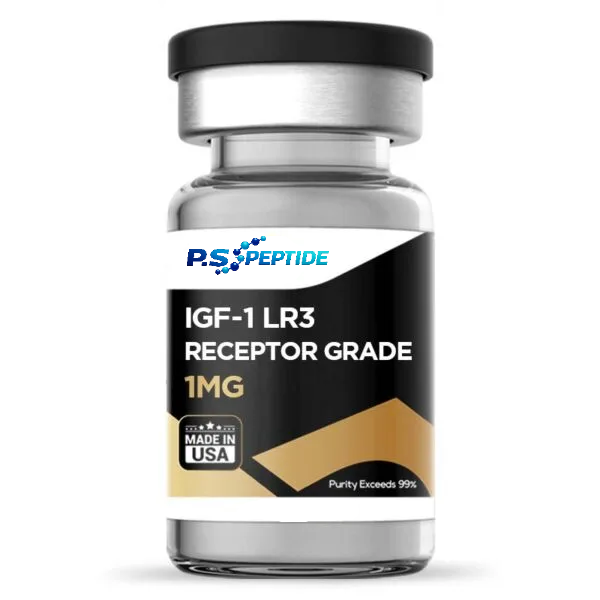
Receptor Grade IGF-1 LR3 (1mg)
$150.00
Size: 1mg
Contents: Receptor Grade IGF-1 LR3 (1mg)
Form: Lyophilized powder
Purity: >99%
FREE Shipping on $200+ orders
| Title | Range | Discount |
|---|---|---|
| 10% Off | 3 - 6 | 10% |
| 15% Off | 7 + | 15% |
Description
eceptor Grade IGF-1 LR3: Peptide for Muscle Growth, Anabolism, and Tissue Repair
IGF-1 LR3, also known as Long arginine 3 IGF-1 or LR3-IGF-1, is a synthetic insulin-like growth factor analog designed for cellular growth and tissue repair. It is an extended version of natural IGF-1 with 83 amino acids (vs. 70 in IGF-1) and an added arginine at position 3, which gives it higher bioavailability and reduced binding to IGF-binding proteins (IGFBPs). This structural modification allows IGF-1 LR3 to persist longer in the body and interact more effectively with target tissues, including muscle, kidney, adrenal, and reproductive tissues.
IGF-1 LR3 has been studied for its potential to stimulate anabolism, enhance lean muscle mass, support metabolic activity, and promote tissue growth in experimental models. It may act via IGF-1 receptor-dependent or IGF-independent mechanisms, triggering autocrine and paracrine signaling pathways in cells.
Chemical Makeup
-
Molecular Formula: C400H625N111O115S9
-
Molecular Weight: 9117.5 g/mol
-
Other Names: Long-(Arg3) insulin-like growth factor-I, Insulin-like growth factor long chain R3
Research and Clinical Insights
IGF-1 LR3 and Tissue Anabolism
Studies suggest it may have superior anabolic potential compared to native IGF-1:
-
In murine models, it was ~2.5 times more potent in promoting organ weight gain and muscle growth.
-
It reduces Nτ-methylhistidine excretion, a marker of muscle protein breakdown, up to three times more than IGF-1.
-
Recombinant IGF-1 (rhIGF-1) studies in humans indicate potential height and tissue growth in IGF-1 deficient models, hinting at similar benefits of LR3 analogs.
IGF-1 LR3 and Metabolic Activity
it may enhance glucose uptake and metabolism via cellular signaling:
-
Activates PI3K/Akt pathway, promoting GLUT4 translocation and glucose entry into cells.
-
May influence AMPK signaling, supporting energy balance under stress.
-
Reduces myostatin action in muscle, potentially increasing lean mass and reducing fat mass.
IGF-1 LR3 and Muscle Health
Research indicates IGF-1 LR3 may support muscle growth and repair:
-
Counters myostatin, a protein that inhibits muscle differentiation.
-
Helps prevent muscle apoptosis and supports muscle cell survival.
-
Prolonged activity due to its extended half-life increases tissue exposure, amplifying potential anabolic effects.
Key Benefits of IGF-1 LR3
-
Enhances lean muscle mass and tissue growth
-
Supports muscle repair and regeneration
-
Promotes glucose metabolism and energy utilization
-
Reduces muscle protein breakdown
-
Potentially improves organ health and metabolic function
Please review and adhere to our Terms and Conditions before ordering.
References:
- Yakar, S et al., 40 YEARS OF IGF1: Insulin-like growth factors: actions on the skeleton (Jul 2018). Journal of Molecular Endocrinology, vol. 61 Issue 1. https://doi.org/10.1530/JME-17-0298
- Growth hormone, athletic performance, and aging. Harvard Health Publishing, Harvard Medical School. https://www.health.harvard.edu/diseases-and-conditions/growth-hormone-athletic-performance-and-aging
- Tomas, F. M., Knowles, S. E., Owens, P. C., Chandler, C. S., Francis, G. L., Read, L. C., & Ballard, F. J. (1992). Insulin-like growth factor-I (IGF-I) and especially IGF-I variants are anabolic in dexamethasone-treated rats. The Biochemical journal, 282 ( Pt 1)(Pt 1), 91–97. https://www.ncbi.nlm.nih.gov/pmc/articles/PMC1130894/
Related products
-
GHK Basic (Tripeptide-1) (200mg)
$155.00 Add to cart -
FOXO4-DRI (10mg)
$220.00 Add to cart -
Pentapeptide-18 (Leuphasyl) (200mg)
$176.00 Add to cart -
BPC-157 & TB-500 Blend (10mg/20mg)
Price range: $100.00 through $190.00 Select options This product has multiple variants. The options may be chosen on the product page
Reviews
There are no reviews yet.