
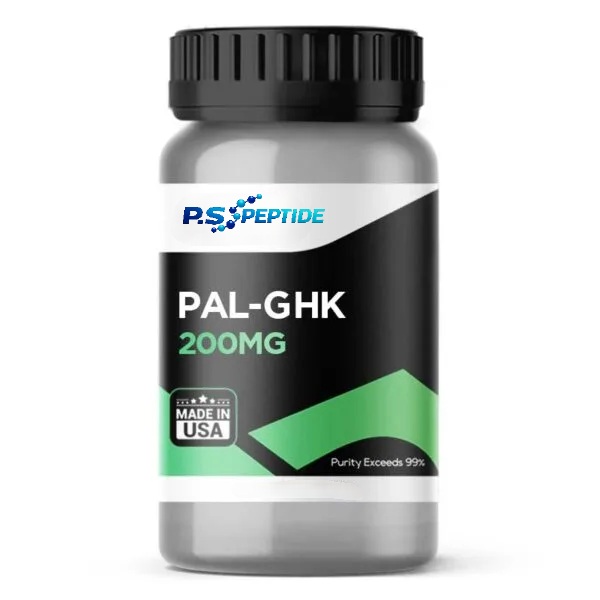
Pal-GHK (200mg)
$175.00
Size: 200mg
Contents: Pal-GHK
Form: Lyophilized powder
Purity: >99%
FREE Shipping on $200+ orders
| Title | Range | Discount |
|---|---|---|
| 10% Off | 3 - 6 | 10% |
| 15% Off | 7 + | 15% |
Description
Pal-GHK Peptide: Collagen, Antioxidation, and Skin Repair
What is Pal-GHK?
Palmitoyl-GHK, also known as Palmitoyl-tripeptide-1, is a synthetic peptide made of three amino acids—Glycine, Histidine, and Lysine—attached to a palmitic acid molecule. The GHK sequence occurs naturally in human plasma, first discovered in 1973 by Pickart et al.
Adding a palmitoyl group enhances lipid solubility, allowing better penetration through the stratum corneum. It may also temporarily disrupt the skin’s lipid barrier, enabling Pal-GHK and other molecules to reach deeper layers of the skin.
Chemical Makeup
-
Molecular Formula: C30H54N6O5
-
Molecular Weight: 578.8 g/mol
-
Other Names: Palmitoyl Tripeptide-1, Palmitoyl Oligopeptide, Biopeptide-CL
Pal-GHK and Collagen Synthesis
Pal-GHK may stimulate collagen production, a critical component of the skin’s extracellular matrix (ECM). The Gly-His-Lys tripeptide is released during collagen hydrolysis and acts as a signal for fibroblasts to produce new collagen, elastin, and glycosaminoglycans.
-
A 1988 study by Maquart et al. suggested GHK fragments promote in situ tissue repair.
-
A placebo-controlled trial of 23 subjects reported a 4% increase in skin thickness after Pal-GHK treatment.
Pal-GHK and Wrinkle Reduction
Clinical studies indicate that Pal-GHK may improve skin texture and reduce wrinkle depth:
-
In a cream-based study with 15 participants, the peptide reportedly reduced wrinkle length, depth, and roughness.
-
When combined with Pal-GQPR (Pal-Gly-Gln-Pro-Arg), a tetrapeptide that reduces IL-6, a study of 28 subjects showed apparent reductions in wrinkle depth, volume, density, and area occupied by deep wrinkles.
Pal-GHK and Antioxidant Activity
This peptide may neutralize free radicals and reduce oxidative stress, potentially slowing skin aging.
-
A 2018 lab study by Sakuma et al. found Pal-GHK suppressed hydroxyl, superoxide, and peroxyl radicals more effectively than carnosine or reduced glutathione.
-
The peptide may prevent protein glycation and combat reactive oxygen species (ROS), reactive nitrogen species (RNS), and reactive carbonyl species (RCS), protecting lipids, DNA, and proteins.
-
It may reduce iron release from ferritin by 87%, limiting lipid peroxidation and preserving cell membrane integrity.
Pal-GHK and Anti-Inflammatory Action
Pal-GHK may reduce inflammation by inhibiting key signaling pathways:
-
Suppresses NF-κB and p38 MAPK, potentially lowering TNF-α and IL-6 production.
-
Reduces infiltration of inflammatory cells in murine lung tissue models.
-
May alleviate oxidative stress in alveolar epithelial cells via Nrf2 activation, increasing antioxidant protein expression and decreasing ROS levels.
Summary
Pal-GHK is a versatile peptide that may:
-
Stimulate collagen and ECM production
-
Reduce wrinkle depth and improve skin texture
-
Protect against oxidative damage
-
Exhibit anti-inflammatory effects
-
Support skin barrier and tissue repair
Please review and adhere to our Terms and Conditions before ordering.
References:
- Pickart, L., & Thaler, M. M. (1973). Tripeptide in human serum which prolongs survival of normal liver cells and stimulates growth in neoplastic liver. Nature: New biology, 243(124), 85–87.
- Gorouhi, F., & Maibach, H. I. (2009). Role of peptides in preventing or treating aged skin. International journal of cosmetic science, 31(5), 327-345.
- Maquart, F. X., Pickart, L., Laurent, M., Gillery, P., Monboisse, J. C., & Borel, J. P. (1988). Stimulation of collagen synthesis in fibroblast cultures by the tripeptide-copper complex glycyl-L-histidyl-L-lysine-Cu2+. FEBS letters, 238(2), 343–346. https://doi.org/10.1016/0014-5793(88)80509-x
- Trookman, N. S., Rizer, R. L., Ford, R., Mehta, R., & Gotz, V. (2009). Clinical assessment of a combination lip treatment to restore moisturization and fullness. The Journal of clinical and aesthetic dermatology, 2(12), 44–48.
- Lintner, K., & Peschard, O. (2000). Biologically active peptides: from a laboratory bench curiosity to a functional skin care product. International journal of cosmetic science, 22(3), 207–218. https://doi.org/10.1046/j.1467-2494.2000.00010.x

Reviews
There are no reviews yet.