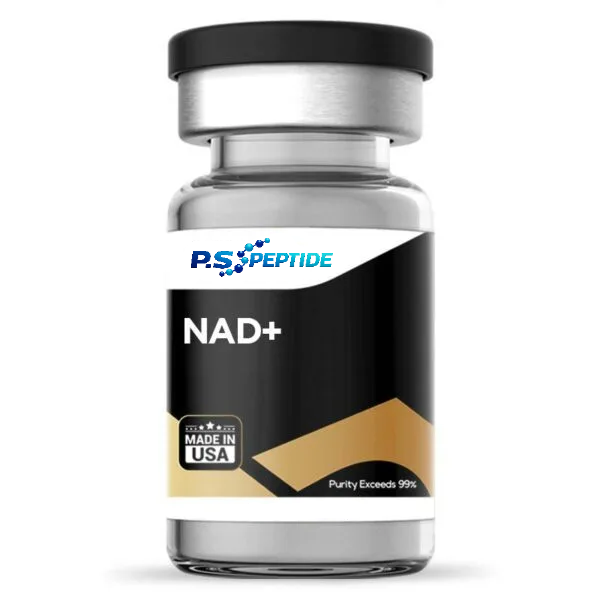
NAD+ Peptide (100mg / 250mg / 750mg)
Price range: $45.00 through $290.00
Size: 100mg / 250mg / 750mg
Contents: NAD+
Form: Lyophilized powder
Purity: >99%
FREE Shipping on $200+ orders
| Title | Range | Discount |
|---|---|---|
| 10% Off | 3 - 6 | 10% |
| 15% Off | 7 + | 15% |
Description
NAD+ Peptide: Energy, DNA Repair, and Cellular Health
What is NAD+?
NAD+ peptide (Nicotinamide Adenine Dinucleotide) is a naturally occurring nucleotide that regulates metabolism, energy production, and DNA repair. It also acts as a secondary messenger via calcium-dependent signaling and may support immune regulation.
NAD+ is synthesized in the body from tryptophan through several enzymatic steps, as well as via intermediates such as nicotinamide, nicotinic acid, nicotinamide riboside (NR), and nicotinamide mononucleotide (NMN). Once produced, NAD+ participates in over 500 enzymatic reactions, primarily acting as a coenzyme in redox processes. It converts into NADH, the energy-carrying form, which fuels multiple metabolic pathways.
NAD+ Peptide Enzymes and Cellular Functions
NAD+ interacts with three major enzyme classes:
-
Sirtuins (SIRTs): Support mitochondrial health, stem cell regeneration, and nerve function.
-
Poly ADP-ribose polymerases (PARPs): Involved in genome stability through poly ADP ribose synthesis.
-
Cyclic ADP-ribose synthetases (cADPRS, e.g., CD38 and CD157): Regulate stem cell regeneration and DNA repair.
Maintaining NAD+ balance is crucial because these enzymes compete for its availability. For example, excessive SIRT activity could reduce PARP function, potentially weakening certain cellular processes.
Chemical Information
-
Molecular Formula: C21H27N7O14P2
-
Molecular Weight: 663.43 g/mol
-
Other Names: Nicotinamide adenine dinucleotide
NAD+ Peptide and Productive Aging
Studies suggest that NAD+ intermediates NMN and NR may promote productive aging. In mice, NMN supplementation for 12 months reportedly:
-
Reduced weight gain
-
Increased energy metabolism
-
Enhanced physical activity
-
Improved lipid profiles
These effects appear to stem from increased NAD+ availability, boosting cellular energy and metabolic function.
Neuroprotective and DNA Repair Effects
NAD+ may improve mitochondrial function in nerve and brain cells. NMN supplementation in aged mice reportedly restored mitochondrial oxygen consumption, supporting cellular energy production.
Additionally, NAD+ is essential for DNA repair through PARP enzymes. PARP uses NAD+ to attach ADP-ribose units to damaged DNA and proteins, facilitating DNA repair and genomic stability. NAD+ supplementation may offset NAD+ depletion during extensive DNA damage, potentially supporting cell survival and repair processes.
Liver and Kidney Health
NAD+ may benefit liver and kidney function. Studies suggest supplementation can:
-
Protect against obesity and alcoholic hepatitis
-
Improve glucose homeostasis
-
Support neuroprotective activity against kidney injury
By activating SIRTs, NAD+ may mitigate glucose-induced kidney hypertrophy and reduce cellular stress.
Skeletal Function and Energy Production
NAD+ plays a critical role in glycolysis and the citric acid (Krebs) cycle. It accepts electrons from glucose, forming NADH, which carries high-energy electrons to the electron transport chain. This process generates ATP, maintaining cellular energy supply. NAD+ regeneration ensures continuous ATP production, supporting muscle function and overall energy metabolism.
Cardiac Functions
NAD+ deficiency may reduce SIRT activity, leading to lower energy production and increased risk of aortic constriction. Supplementation with NMN in mice before ischemic events reportedly provided cardioprotective effects, improving heart resilience and reducing ischemic injury.
Please review and adhere to our Terms and Conditions before ordering.
References:
- Schultz, Michael B, and David A Sinclair. “Why NAD(+) Declines during Aging: It’s Destroyed.” Cell metabolism vol. 23,6 (2016): 965-966. https://www.ncbi.nlm.nih.gov/pmc/articles/PMC5088772/
- Braidy N, Liu Y. NAD+ therapy in age-related degenerative disorders: A benefit/risk analysis. Exp Gerontol. 2020 Apr;132:110831. doi: 10.1016/j.exger.2020.110831. https://pubmed.ncbi.nlm.nih.gov/31917996/
- Johnson, Sean, and Shin-Ichiro Imai. “NAD + biosynthesis, aging, and disease.” F1000Research vol. 7 132. 1 Feb 2018. https://www.ncbi.nlm.nih.gov/pmc/articles/PMC5795269/
- Bieganowski P, Brenner C. Discoveries of nicotinamide riboside as a nutrient and conserved NRK genes establish a Preiss-Handler independent route to NAD+ in fungi and humans. Cell. 2004 May 14;117(4):495-502. https://pubmed.ncbi.nlm.nih.gov/15137942/
Additional information
| Choose Option | 100mg, 250mg, 700mg |
|---|
Reviews
There are no reviews yet.