
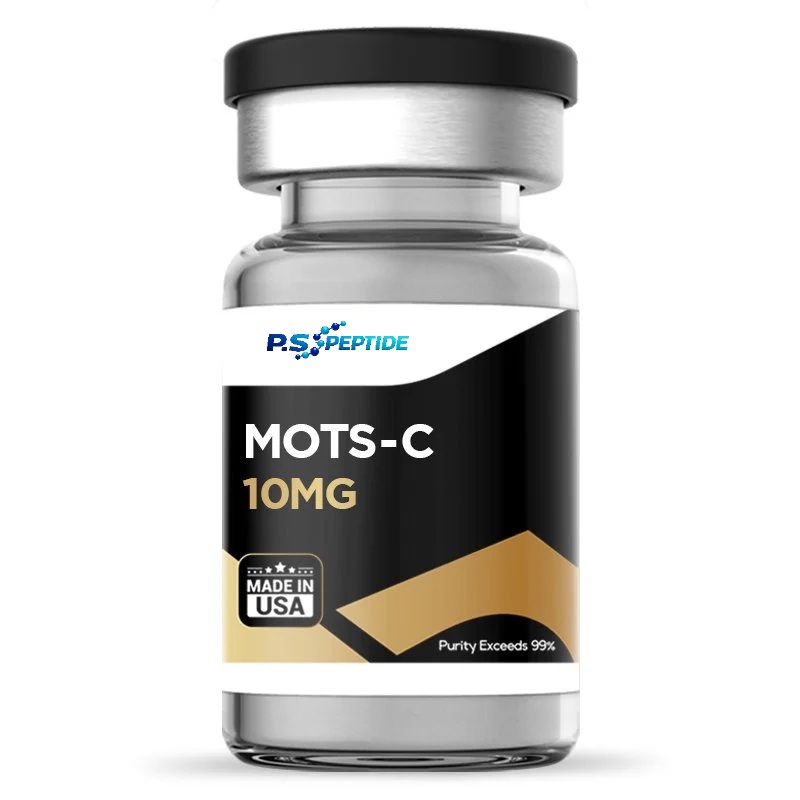
MOTS-C (10mg)
Original price was: $115.00.$100.00Current price is: $100.00.
Size: 10mg
Contents: MOTS-C
Form: Lyophilized powder
Purity: >99%
FREE Shipping on $200+ orders
| Title | Range | Discount |
|---|---|---|
| 10% Off | 3 - 6 | 10% |
| 15% Off | 7 + | 15% |
Description
MOTS-c Peptide
Mitochondria-Derived Metabolic Research Peptide
MOTS-c peptide (mitochondrial open-reading-frame of the 12S rRNA-c) is a mitochondria-derived peptide (MDP) studied for its potential role in metabolism and cellular signaling. Unlike traditional peptides, MOTS-c originates from mitochondrial DNA. Therefore, researchers often explore it in studies involving metabolic regulation, aging pathways, and cellular energy balance.
This short peptide contains 16 amino acids and appears in multiple tissues and circulating plasma. As a result, scientists frequently investigate its dual role as both a cell-signaling molecule and a hormone-like compound. Because of its systemic activity, MOTS-c is often described as a “mitochondrial hormone” or mitokine.
How MOTS-c Peptide Works
Research suggests that MOTS-c may regulate metabolic stress responses through the AMP-activated protein kinase (AMPK) pathway. During metabolic stress, the peptide may translocate to the nucleus and influence gene expression. Consequently, researchers explore MOTS-c for its potential role in mitonuclear communication and adaptive metabolism.
In addition, MOTS-c may interact with longevity-related regulators such as NAD+ and sirtuins. Therefore, scientists continue studying its possible involvement in aging biology and metabolic resilience.
Chemical Makeup
Molecular Formula: C101H152N28O22S2
Molecular Weight: 2174.64 g/mol
Other Titles:
-
Mitochondrial-derived peptide MOTS-c
-
Mitochondrial open reading frame of the 12S rRNA-c
MOTS-c Peptide Research Applications
MOTS-c and Muscle Metabolism
Researchers frequently study MOTS-c in skeletal muscle metabolism models. With age, skeletal muscle often develops insulin resistance and reduced glucose uptake. However, experimental findings suggest that MOTS-c may activate AMPK signaling and enhance glucose transporter expression.
As a result, studies indicate potential improvements in glucose uptake, lipid utilization, and metabolic flexibility. Furthermore, MOTS-c may influence the folate-methionine cycle and purine biosynthesis. These interactions may shift metabolic priorities within the cell and support balanced anabolic and catabolic activity.
Because circulating MOTS-c levels may affect systemic metabolism, scientists continue exploring its hormonal role in muscle and adipose tissue signaling.
MOTS-c and Fat Cell Metabolism
MOTS-c may also translocate from mitochondria to the nucleus and regulate gene expression. Specifically, researchers suggest interactions with antioxidant response elements (ARE) and stress-responsive transcription factors such as NRF2.
In experimental high-fat diet models, MOTS-c exposure appears to influence AMPK activation and metabolic homeostasis. Additionally, findings suggest modulation of the methionine-folate cycle and glucose utilization pathways.
Consequently, some models demonstrate reduced fat accumulation and increased metabolic efficiency. Because of these observations, researchers investigate MOTS-c in metabolic syndrome and insulin sensitivity studies.
MOTS-c and Bone Research
Emerging studies suggest that MOTS-c may influence bone biology through the TGF-beta/SMAD signaling pathway. For example, research indicates upregulation of osteogenic markers such as:
-
ALP
-
Bglap
-
Runx2
Moreover, activation of TGF-beta–related genes may support osteogenic differentiation. When studied in bone marrow models, MOTS-c appears to promote stem cell differentiation into bone-forming cells. Therefore, researchers explore its potential role in bone density and skeletal development research.
MOTS-c and Vascular Function
Although MOTS-c may not directly regulate cardiac tissue, researchers study its potential impact on endothelial function. Endothelial cells control vascular tone, clotting, and blood pressure regulation.
Some findings suggest a correlation between MOTS-c levels and improved endothelial responsiveness. Additionally, experimental exposure appears to support microvascular function in certain models. Because AMPK activation influences vascular health, scientists continue evaluating MOTS-c as a metabolic biomarker candidate.
MOTS-c and Cellular Longevity
MOTS-c also attracts interest in aging and longevity research. Studies suggest that mitochondrial peptides may influence lifespan through endocrine-like signaling. Furthermore, structural variations in the peptide sequence may alter biological activity, highlighting its potential complexity.
Because MOTS-c interacts with mitochondrial and nuclear signaling pathways, researchers continue investigating its role in cellular aging and longevity mechanisms.
Why Researchers Study MOTS-c Peptide
Researchers explore MOTS-c because it offers:
-
Mitochondria-derived signaling activity
-
AMPK pathway modulation
-
Hormone-like systemic effects
-
Potential aging pathway involvement
-
Metabolic adaptability research value
Therefore, MOTS-c remains a key candidate in studies involving metabolism, longevity, and mitochondrial biology.
Please review and adhere to our Terms and Conditions before ordering.
References:
- Lee C, Kim KH, Cohen P. MOTS-c: A novel mitochondrial-derived peptide regulating muscle and fat metabolism. Free Radic Biol Med. 2016 Nov;100:182-187. doi: 10.1016/j.freeradbiomed.2016.05.015. Epub 2016 May 20. PMID: 27216708; PMCID: PMC5116416. https://www.ncbi.nlm.nih.gov/pmc/articles/PMC5116416/
- Mohtashami Z, Singh MK, Salimiaghdam N, Ozgul M, Kenney MC. Most Recent Mitochondrial Derived Peptide in Human Aging and Age-Related Diseases. Int J Mol Sci. 2022 Oct 9;23(19):11991. doi: 10.3390/ijms231911991. PMID: 36233287; PMCID: PMC9570330.


Reviews
There are no reviews yet.