
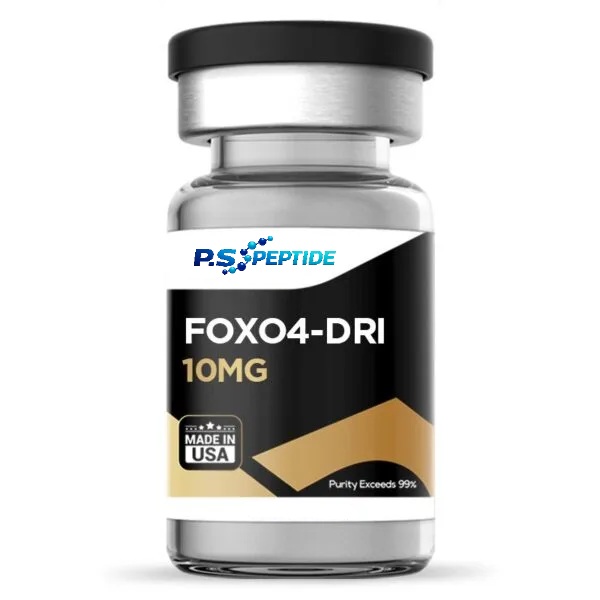
FOXO4-DRI (10mg)
$220.00
Size: 10mg
Contents: FOXO4-DRI (10mg)
Form: Lyophilized powder
Purity: >99%
FREE Shipping on $200+ orders
| Title | Range | Discount |
|---|---|---|
| 10% Off | 3 - 6 | 10% |
| 15% Off | 7 + | 15% |
Description
FOXO4-DRI Peptide Overview
FOXO4-DRI peptide is a synthetic, retro-inverso peptide developed from a fragment of the endogenous FOXO4 transcription factor. FOXO transcription factors belong to the forkhead family and include FOXO1, FOXO3, FOXO4, and FOXO6. These proteins regulate critical cellular pathways, including insulin signaling, cell cycle progression, growth, and differentiation.
Researchers designed FOXO4-DRI to replicate a specific region of the FOXO4 protein that interacts with p53, a key regulator of apoptosis and cell cycle control. However, FOXO4-DRI differs structurally because its amino acids exist in the D-form rather than the natural L-form. As a result, the peptide may demonstrate increased stability and resistance to degradation when compared to endogenous FOXO4.
What Is FOXO4-DRI (Retro-Inverso Peptide)?
Retro-inverso peptides, also known as DRI peptides, reverse the amino acid sequence and chirality of natural peptides. In this configuration, D-amino acids replace L-amino acids. Therefore, the resulting peptide often exhibits enhanced durability against enzymatic breakdown.
FOXO4-DRI, also referred to as Proxofim, retains the functional binding characteristics of FOXO4 while potentially resisting rapid cellular clearance. However, this structural modification may also influence how the peptide interacts with intracellular targets.
Mechanism of Action
The primary focus of FOXO4-DRI peptide research centers on its ability to disrupt the FOXO4–p53 interaction. Under normal conditions, FOXO4 can bind to p53 and restrict its ability to attach to DNA. Consequently, this interaction may suppress apoptosis and allow senescent cells to persist.
However, FOXO4-DRI may competitively block FOXO4 from binding to p53. As a result, p53 may regain its ability to bind DNA and activate apoptosis pathways. Therefore, FOXO4-DRI may promote the selective removal of senescent cells, which are non-dividing cells that accumulate with age and contribute to tissue dysfunction.
Importantly, researchers report that FOXO4-DRI appears selective, primarily affecting aging or dysfunctional cells rather than healthy cells. This selectivity may support improved tissue function, cellular turnover, and differentiation in research models.
Chemical Makeup
-
Molecular Formula: C₂₂₈H₃₈₈N₈₆O₆₄
-
Molecular Weight: 5,358.05 g/mol
-
Other Names: Forkhead box protein O4, Proxofim, FOXO4a, AFX, AFX1, MLLT7
Research and Experimental Findings
FOXO4-DRI and Cellular Senescence
Research indicates that FOXO4-DRI does not completely stop senescence. However, it may reduce resistance to apoptosis in senescent cells. Elevated FOXO4 levels in aging cells appear to protect these cells from programmed death by interacting with p53.
In a 2017 study using aged mouse models, researchers observed improved physical fitness, enhanced kidney function, and increased fur density following FOXO4-DRI exposure. These improvements may correlate with a reduced burden of senescent cells and lower activity of the senescence-associated secretory phenotype (SASP), which promotes chronic inflammation.
FOXO4-DRI and Cardiovascular Function
Proteasome activity naturally declines with age, reducing the clearance of damaged cells. FOXO4 influences proteasome regulation, although it does not directly remove dysfunctional cells. FOXO4-DRI may support endogenous cleanup mechanisms while also promoting the elimination of senescent cells, thereby supporting tissue homeostasis.
FOXO4-DRI and Insulin Signaling
FOXO4 activity connects closely to the insulin and insulin-like growth factor signaling (IIS) pathway. This pathway influences stress resistance, metabolic regulation, and cellular longevity. Therefore, FOXO4-DRI may indirectly affect how cells respond to environmental stressors and metabolic signals associated with aging.
FOXO4-DRI and Oxidative Stress
FOXO4 plays a regulatory role in oxidative stress responses. Under oxidative or inflammatory stress, signaling pathways involving MST1, JNK, and p38 AMPK activate FOXO4. Once activated, FOXO4 translocates to the nucleus and promotes transcription of antioxidant enzymes such as MnSOD, catalase, and glutathione peroxidase.
Interestingly, FOXO4-DRI may inhibit FOXO4 nuclear translocation specifically in senescent cells. As a result, it may limit stress-response signaling in dysfunctional cells while preserving healthy cell function.
FOXO4-DRI and Neurological Research
Proteasome dysfunction has been associated with neurodegenerative disease models. Studies suggest FOXO protein levels may change within the central nervous system during disease progression. Consequently, researchers hypothesize that exogenous FOXO4-DRI may help regulate FOXO activity and maintain cellular balance in neurological research models.
FOXO4-DRI and Hypogonadism Research
Researchers have also examined FOXO4-DRI in senescent Leydig cell models, which play a critical role in testosterone synthesis. In vitro findings suggest FOXO4 translocates to the nucleus during senescence and helps maintain cell survival.
However, FOXO4-DRI exposure appeared to block FOXO4–p53 interaction. As a result, p53 regained DNA-binding activity, which triggered apoptosis in senescent Leydig cells. These findings suggest FOXO4-DRI may selectively target aging cells linked to reduced hormonal output.
Please review and adhere to our Terms and Conditions before ordering.
References:
- Babu MM, Luscombe NM, Aravind L, Gerstein M, Teichmann SA. Structure and evolution of transcriptional regulatory networks. Curr Opin Struct Biol. 2004 Jun;14(3):283-91. https://pubmed.ncbi.nlm.nih.gov/15193307/
- Sun, Yan et al. “FOXO4 Inhibits the Migration and Metastasis of Colorectal Cancer by Regulating the APC2/β-Catenin Axis.” Frontiers in cell and developmental biology vol. 9 659731. 23 Sep. 2021. https://www.ncbi.nlm.nih.gov/pmc/articles/PMC8495124/
- Huang, Yuzhao et al. “Senolytic Peptide FOXO4-DRI Selectively Removes Senescent Cells From in vitro Expanded Human Chondrocytes.” Frontiers in bioengineering and biotechnology vol. 9 677576. 29 Apr. 2021, https://www.ncbi.nlm.nih.gov/pmc/articles/PMC8116695/
- Zhang, C., Xie, Y., Chen, H., Lv, L., Yao, J., Zhang, M., Xia, K., Feng, X., Li, Y., Liang, X., Sun, X., Deng, C., & Liu, G. (2020). FOXO4-DRI alleviates age-related testosterone secretion insufficiency by targeting senescent Leydig cells in aged mice. Aging, 12(2), 1272–1284. https://www.ncbi.nlm.nih.gov/pmc/articles/PMC7053614/
- Krimpenfort P, Berns A. Rejuvenation by Therapeutic Elimination of Senescent Cells. Cell. 2017 Mar 23;169(1):3-5. https://pubmed.ncbi.nlm.nih.gov/28340347/
- Marjolein P. Baar et al, Targeted Apoptosis of Senescent Cells Restores Tissue Homeostasis in Response to Chemotoxicity and Aging. Vol 169 Issue 1, https://doi.org/10.1016/j.cell.2017.02.031
- Anne-Laure Bulteau, Luke I. Szweda, Bertrand Friguet, Age-Dependent Declines in Proteasome Activity in the Heart, Archives of Biochemistry and Biophysics, Volume 397, Issue 2, 2002, Pages 298-304, ISSN 0003-9861, https://doi.org/10.1006/abbi.2001.2663
Related products
-
Decapeptide-12 (200mg)
$230.00 Add to cart -
BPC-157 & TB-500 & GHK-Cu Blend (70mg)
$300.00 Add to cart -
BPC-157 & TB-500 Blend (10mg/20mg)
Price range: $100.00 through $190.00 Select options This product has multiple variants. The options may be chosen on the product page -
GHK-Cu (200mg)
$195.00 Add to cart
Reviews
There are no reviews yet.