
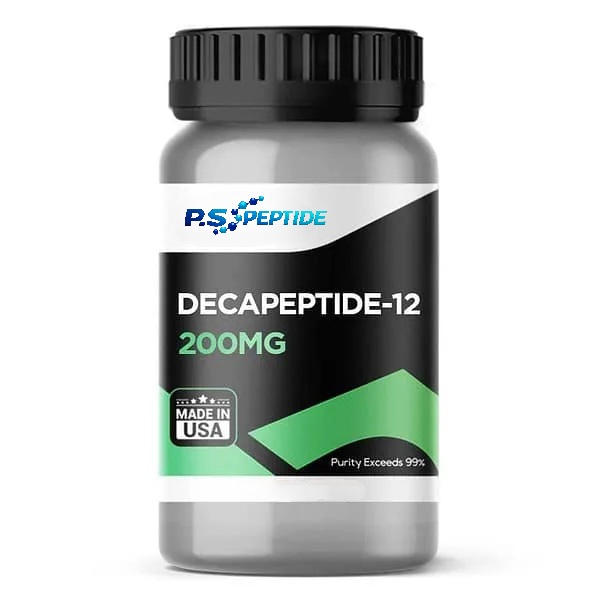
Decapeptide-12 (200mg)
$230.00
Size: 200mg
Contents: Decapeptide-12
Form: Lyophilized powder
Purity: >99%
FREE Shipping on $200+ orders
| Title | Range | Discount |
|---|---|---|
| 10% Off | 3 - 6 | 10% |
| 15% Off | 7 + | 15% |
Description
Decapeptide-12 Overview
Decapeptide-12 is a synthetic peptide composed of 10 amino acids. Researchers designed it specifically to exhibit targeted biochemical properties. Unlike many peptides, Decapeptide-12 does not appear to mimic any naturally occurring sequence.
Primarily, researchers investigate Decapeptide-12 for its potential to reduce melanin production. In particular, studies suggest it may suppress the activity of tyrosinase, an enzyme involved in melanin synthesis. Additionally, researchers have explored its potential influence on cell growth, differentiation, and cellular aging. However, further studies remain necessary to clarify these effects.
Chemical Makeup
-
Molecular Formula: C₆₅H₉₀N₁₈O₁₇
-
Molecular Weight: 1,311.46 g/mol
Mechanism of Action
As noted, Decapeptide-12 is primarily studied for its role in melanogenesis inhibition. Melanogenesis refers to the biochemical process through which specialized skin cells, called melanocytes, produce melanin.
Tyrosinase plays a critical role in this pathway. Specifically, it catalyzes the conversion of tyrosine into DOPA and subsequently into DOPAquinone. These steps are essential for producing eumelanin and pheomelanin, the pigments responsible for skin, hair, and eye color.
Decapeptide-12 may reduce melanin synthesis by inhibiting tyrosinase activity. For example, the peptide may bind directly to the enzyme or interact with its mRNA. As a result, tyrosinase may lose catalytic efficiency or become less available inside melanocytes. Consequently, melanin production may decrease. Although the full molecular pathway remains complex, research consistently highlights tyrosinase inhibition as the primary mechanism.
Research and Clinical Studies
Decapeptide-12 and Melasma
Several clinical studies have evaluated Decapeptide-12 in subjects with melasma. For instance, one 24-week study involving 25 participants reported visible improvements in melasma, solar lentigines, periocular lines, and wrinkles, with sustained results. (1)
Similarly, another 16-week trial involving 33 subjects with mild-to-moderate melasma reported noticeable reductions in pigmentation. (2)
Moreover, one study reported complete melasma clearance in 25% of participants after six weeks. (3) Researchers also observed positive outcomes in subjects with Fitzpatrick skin type IV, a group commonly affected by melasma. (4) Overall, investigators concluded that all participants demonstrated statistically significant improvement in melasma appearance and facial aesthetics.
Decapeptide-12 and Post-Inflammatory Hyperpigmentation
In addition to melasma, researchers have studied Decapeptide-12 for post-inflammatory hyperpigmentation (PIH). A clinical case study involving Fitzpatrick skin type IV suggested that Decapeptide-12 accelerated pigmentation clearance when compared to placebo. (5)
Importantly, researchers attributed this effect to the peptide’s tyrosinase-inhibiting properties. (6)
Decapeptide-12 and Solar Lentigines
Researchers have also examined Decapeptide-12 in models of solar lentigines, a form of hyperpigmentation caused by chronic sun exposure. One 24-week study reported that 38.5% of participants achieved complete clearance, while all subjects showed measurable improvement. (7)
Furthermore, researchers observed reductions in photodamage severity across all evaluated subjects. As a result, Decapeptide-12 demonstrated potential relevance in pigmentation research linked to UV-induced skin changes.
Decapeptide-12 and Cellular Aging Research
Sirtuins represent a family of genes involved in cellular metabolism, DNA repair, inflammation regulation, and stress resistance. Among them, SIRT1 plays a key role in cellular stress response and metabolic regulation.
One study investigated the effects of Decapeptide-12 on sirtuin gene expression in keratinocyte progenitor cells. Researchers used RT-PCR to measure transcription levels after 72 hours of exposure. (8)
The results indicated increased transcription of several sirtuin genes, including SIRT1, SIRT3, SIRT6, and SIRT7, alongside reduced cytotoxicity. Specifically, researchers reported a 141 ± 11% increase in SIRT1 transcription, with notable increases in SIRT3, SIRT6, and SIRT7 as well.
As a result, researchers suggested that Decapeptide-12 may enhance cellular resilience, mitochondrial efficiency, DNA repair mechanisms, and stress response pathways. While SIRT7 modulation appeared less pronounced, it may still support nucleolar function and cellular homeostasis. Overall, these findings highlight Decapeptide-12 as a peptide of interest in cellular aging research, although further investigation remains necessary.
Please review and comply with our Terms and Conditions before ordering.
References:
- Jiang, L., Hino, P. D., Bhatia, A., Stephens, T. J., & Jimenez, F. (2018). Efficacy of Trifecting® Night Cream, a Novel Triple acting Skin Brightening Product: A Double-blind, Placebo-controlled Clinical Study. The Journal of clinical and aesthetic dermatology, 11(12), 21–25.
- Ramírez, S. P., Carvajal, A. C., Salazar, J. C., Arroyave, G., Flórez, A. M., & Echeverry, H. F. (2013). Open-label evaluation of a novel skin brightening system containing 0.01% decapeptide-12 in combination with 20% buffered glycolic acid for the treatment of mild to moderate facial melasma. Journal of drugs in dermatology : JDD, 12(6), e106–e110.
- Hantash, B. M., & Jimenez, F. (2012). Treatment of mild to moderate facial melasma with the Lumixyl brightening system. Journal of drugs in dermatology : JDD, 11(5), 660–662.
- Hantash, B. M., & Jimenez, F. (2009). A split-face, double-blind, randomized and placebo-controlled pilot evaluation of a novel oligopeptide for the treatment of recalcitrant melasma. Journal of drugs in dermatology : JDD, 8(8), 732–735.
- Bhatia, A., Hsu, J. T.s, & Hantash, B. M. (2014). Combined delivery and dermalinfusion of decapeptide-12 accelerates resolution of post-inflammatory hyperpigmentation in skin of color. Journal of drugs in dermatology : JDD, 13(1), 84–85.
- Chen, J., Bian, J., Hantash, B. M., Albakr, L., Hibbs, D. E., Xiang, X., Xie, P., Wu, C., & Kang, L. (2021). Enhanced skin retention and permeation of a novel peptide via structural modification, chemical enhancement, and microneedles. International journal of pharmaceutics, 606, 120868. https://doi.org/10.1016/j.ijpharm.2021.120868
- Kassim, A. T., Hussain, M., & Goldberg, D. J. (2012). Open-label evaluation of the skin-brightening efficacy of a skin-brightening system using decapeptide-12. Journal of cosmetic and laser therapy : official publication of the European Society for Laser Dermatology, 14(2), 117–121. https://doi.org/10.3109/14764172.2012.672745
- Basil, M. H., & Anan, A. U. (2019). Tyrosinase inhibitors with potent anti-senescence activity in human neonatal keratinocyte progenitors. J Dermatol Surg Res Ther, 2019, 30-39.
Related products
-
NAD+ Peptide (100mg / 250mg / 750mg)
Price range: $45.00 through $290.00 Select options This product has multiple variants. The options may be chosen on the product page -
Sale!
ACE-031 (1mg)
Original price was: $173.00.$170.00Current price is: $170.00. Add to cart -
Pal-AHK (200mg)
$175.00 Add to cart -
Matrixyl (200mg)
$171.00 Add to cart
Reviews
There are no reviews yet.