
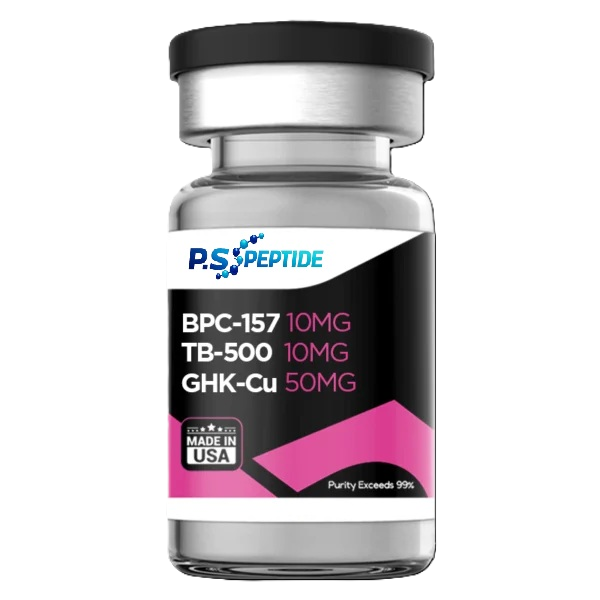
BPC-157 & TB-500 & GHK-Cu Blend (70mg)
$300.00
Size: 70mg
Contents: BPC-157 (10mg) & TB-500 (10mg) & GHK-Cu (50mg)
Form: Lyophilized powder
Purity: >99%
FREE Shipping on $200+ orders
| Title | Range | Discount |
|---|---|---|
| 10% Off | 3 - 6 | 10% |
| 15% Off | 7 + | 15% |
Description
BPC-157, TB-500 & GHK-Cu Research Peptide Blend
The BPC-157, TB-500, and GHK-Cu blend combines three extensively studied research peptides. Each compound interacts with cellular systems through distinct mechanisms. However, research suggests their actions may overlap in key biological pathways.
As a result, investigators often explore these peptides together when examining inflammatory signaling, cellular behavior, angiogenesis, and structural repair in laboratory settings.
Individual Peptide Overview
BPC-157 (Body Protection Compound-157)
BPC-157 is a synthetic peptide made of 15 amino acids. Researchers believe it originates from a gastric protein fragment, although they have not yet confirmed the exact precursor.
Studies indicate that BPC-157 interacts with intracellular signaling pathways involved in vascular regulation and inflammation. Specifically, research models suggest it may support angiogenic signaling while reducing excessive pro-inflammatory activity. (1)
TB-500 (Synthetic Thymosin Beta-4)
TB-500 is a synthetic version of the naturally occurring thymosin beta-4, consisting of 43 amino acids. Researchers have examined it for its role in cell migration, cytoskeletal organization, and inflammatory signaling.
In vitro studies show that TB-500 supports cell movement and structural coordination. Additionally, findings suggest it may participate in signaling pathways associated with angiogenesis and inflammatory modulation. (2)
GHK-Cu (Glycyl-L-Histidyl-L-Lysine Copper Complex)
GHK-Cu consists of the tripeptide GHK bound to a divalent copper ion (Cu²⁺). Cells such as fibroblasts, macrophages, and lymphocytes may release the GHK sequence during tissue damage and collagen breakdown. (3)
Because of this, researchers propose that GHK-Cu functions as a cellular repair signal. It may interact with enzymes, ion channels, and cell-surface receptors. Moreover, copper appears to play a critical role in collagen synthesis, antioxidant activity, and inflammatory regulation.
Complementary Research Actions
Individually, each peptide acts through unique pathways. However, research suggests they may work synergistically under experimental conditions.
Together, these peptides may influence:
-
Inflammatory signaling balance
-
Vascular formation and stability
-
Cellular migration and organization
-
Structural repair processes
That said, researchers have not yet conducted large-scale studies examining all three peptides simultaneously.
Chemical Characteristics
Molecular Formulas
-
BPC-157: C₆₂H₉₈N₁₆O₂₂
-
TB-500: C₂₁₂H₃₅₀N₅₆O₇₈S
-
GHK-Cu: C₁₄H₂₃CuN₆O₄
Molecular Weights
-
BPC-157: ~1,419 g/mol
-
TB-500: ~4,963 g/mol
-
GHK-Cu: ~403 g/mol
Alternative Names
-
BPC-157: Body Protection Compound-157
-
TB-500: Synthetic Thymosin Beta-4
-
GHK-Cu: Glycyl-L-Histidyl-L-Lysine Copper (II)
Anti-Inflammatory Signaling Research
Research indicates that all three peptides may influence intracellular inflammatory signaling, although they do so through different mechanisms.
For example, Santra et al. demonstrated that TB-500 increased miR-146a levels in oligodendrocyte progenitor cells. As a result, Toll-like receptor signaling and downstream NF-κB activation decreased. (4)
Similarly, Šikiric et al. reported that BPC-157 reduced inflammatory cell infiltration and lowered markers such as leukotriene B4 and thromboxane B2. Importantly, these effects occurred without direct cytokine suppression, which suggests a regulatory rather than immunosuppressive role. (5)
Additionally, Park et al. found that GHK-Cu reduced oxidative stress and lowered TNF-α and IL-6 levels in activated macrophages and lung injury models. Furthermore, antioxidant enzyme activity returned closer to baseline levels. (6)
Cellular Regeneration and Angiogenesis Research
Beyond inflammation, researchers have also examined these peptides for their role in cellular regeneration and vascular support.
For instance, Lv et al. showed that TB-500 enhanced endothelial migration and tube formation. Moreover, it increased expression of VEGF-A, Ang2, and Tie2, potentially through a Notch/NF-κB signaling pathway. (7)
Likewise, studies indicate that BPC-157 supports endothelial stability and vessel patency. Researchers also linked it to activation of Egr-1/NAB2 and FAK-paxillin signaling, which are essential for cell adhesion and migration. (8)
Meanwhile, GHK-Cu has demonstrated the ability to upregulate VEGF, promote endothelial proliferation, and support tube formation. Since copper acts as a cofactor for angiogenic enzymes, the peptide may deliver copper in a biologically functional form. (9)
Collagen and Structural Repair Research
Multiple studies suggest these peptides may also support collagen organization and connective tissue integrity.
For example, Xu et al. observed improved collagen alignment and increased tensile strength in tendon fibroblast models exposed to TB-500. (10)
In addition, research shows that BPC-157 accelerated fibroblast migration and enhanced cell survival under oxidative stress. These effects correlated with increased F-actin formation and focal adhesion signaling, both of which support tissue repair. (11)
Finally, GHK-Cu has demonstrated support for collagen synthesis and tendon-to-bone integration in laboratory models, suggesting a role in connective tissue remodeling. (12)
Please review our Terms and Conditions before ordering.
References:
- Seiwerth S, Milavic M, Vukojevic J, Gojkovic S, Krezic I, Vuletic LB, Pavlov KH, Petrovic A, Sikiric S, Vranes H, Prtoric A, Zizek H, Durasin T, Dobric I, Staresinic M, Strbe S, Knezevic M, Sola M, Kokot A, Sever M, Lovric E, Skrtic A, Blagaic AB, Sikiric P. Stable Gastric Pentadecapeptide BPC 157 and Wound Healing. Front Pharmacol. 2021 Jun 29;12:627533. doi: 10.3389/fphar.2021.627533. PMID: 34267654; PMCID: PMC8275860.
- Maar, K., Hetenyi, R., Maar, S., Faskerti, G., Hanna, D., Lippai, B., Takatsy, A., & Bock-Marquette, I. (2021). Utilizing Developmentally Essential Secreted Peptides Such as Thymosin Beta-4 to Remind the Adult Organs of Their Embryonic State-New Directions in Anti-Aging Regenerative Therapies. Cells, 10(6), 1343. https://doi.org/10.3390/cells10061343
- Maquart FX, Pickart L, Laurent M, Gillery P, Monboisse JC, Borel JP. Stimulation of collagen synthesis in fibroblast cultures by the tripeptide-copper complex glycyl-L-histidyl-L-lysine-Cu2+. FEBS Lett. 1988 Oct 10;238(2):343-6. doi: 10.1016/0014-5793(88)80509-x. PMID: 3169264.
- Santra M, Zhang ZG, Yang J, Santra S, Santra S, Chopp M, Morris DC. Thymosin β4 up-regulation of microRNA-146a promotes oligodendrocyte differentiation and suppression of the Toll-like proinflammatory pathway. J Biol Chem. 2014 Jul 11;289(28):19508-18. doi: 10.1074/jbc.M113.529966. Epub 2014 May 14. PMID: 24828499; PMCID: PMC4094061.
- Sikiric P, Seiwerth S, Rucman R, Turkovic B, Rokotov DS, Brcic L, Sever M, Klicek R, Radic B, Drmic D, Ilic S, Kolenc D, Stambolija V, Zoricic Z, Vrcic H, Sebecic B. Focus on ulcerative colitis: stable gastric pentadecapeptide BPC 157. Curr Med Chem. 2012;19(1):126-32. doi: 10.2174/092986712803414015. PMID: 22300085.
Related products
-
Pal-AHK (200mg)
$175.00 Add to cart -
Sale!
ACE-031 (1mg)
Original price was: $173.00.$170.00Current price is: $170.00. Add to cart -
NAD+ Peptide (100mg / 250mg / 750mg)
Price range: $45.00 through $290.00 Select options This product has multiple variants. The options may be chosen on the product page -
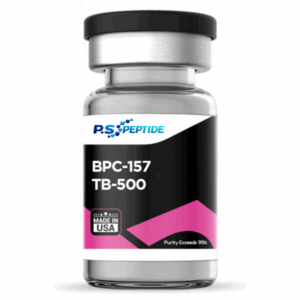
BPC-157 & TB-500 Blend (10mg/20mg)
Price range: $100.00 through $190.00 Select options This product has multiple variants. The options may be chosen on the product page
Reviews
There are no reviews yet.