
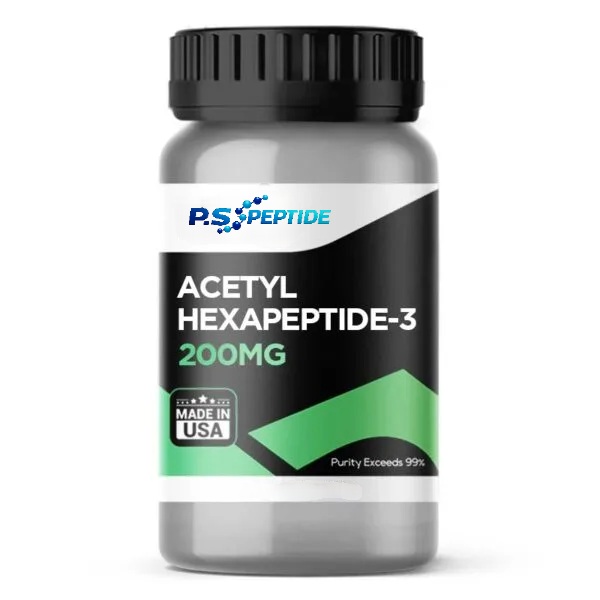
Acetyl Hexapeptide-3 (Argireline) (200mg)
$220.00
Size: 200mg
Contents: Acetyl Hexapeptide-3 (Argireline)
Form: Lyophilized powder
Purity: >99%
FREE Shipping on $200+ orders
| Title | Range | Discount |
|---|---|---|
| 10% Off | 3 - 6 | 10% |
| 15% Off | 7 + | 15% |
Description
Acetyl Hexapeptide-3
Overview
Acetyl Hexapeptide-3 is a synthetic peptide widely researched for its potential role in reducing wrinkle formation in skin tissues. Researchers originally developed this peptide as a competitive inhibitor of SNAP-25 (synaptosome-associated protein 25 kDa), a key component of the SNARE complex. This complex regulates calcium-dependent synaptic vesicle exocytosis, which plays a crucial role in cellular communication and signal transmission.
Because Acetyl Hexapeptide-3 closely resembles the N-terminal amino acid sequence of SNAP-25, researchers hypothesize that it may interfere with SNARE complex formation. As a result, this interaction may reduce the exocytosis of signaling messengers. In particular, studies suggest that the peptide may limit the release of acetylcholine, a neurotransmitter involved in muscle contraction and nerve-to-muscle communication.
Research Significance
Compared to bacterial neurotoxins, Acetyl Hexapeptide-3 is often considered a milder and less invasive research alternative. Researchers believe the peptide may act directly within skin tissues and potentially reach superficially underlying muscle cells. Therefore, it has gained attention in skin and muscle tissue research.
In addition, scientists have explored its potential relevance in collagen synthesis, muscle spasms, scarring processes, and pain-related cellular signaling. Notably, palmitoylated forms of the peptide have also been investigated for their interaction with pain-mediating neurons.
Chemical Properties
-
Molecular Formula: C₃₄H₆₀N₁₄O₁₂S
-
Molecular Weight: 888.99 g/mol
-
Also Known As: Acetyl Hexapeptide-8, Argireline®
Research and Clinical Findings
Wrinkle and Skin Structure Studies
Acetyl Hexapeptide-3 was designed to mimic certain mechanisms associated with botulinum neurotoxins while maintaining the ability to penetrate skin layers. In one clinical study, researchers observed an apparent reduction in wrinkle depth of up to 30% after 30 days of topical exposure in test subjects.
Furthermore, a randomized, placebo-controlled study involving 24 participants reported similar improvements. Researchers measured skin microtopography and transepidermal water loss (TEWL) throughout the trial. The findings suggested improved skin hydration and possible anti-wrinkle activity, regardless of skin type.
Additional clinical data supports these observations. For example, a separate study involving 52 participants reported noticeable improvements in wrinkle morphology and skin hydration after 29 days. Another investigation noted an overall anti-wrinkle efficiency of nearly 49% when compared to placebo.
Animal research has also explored underlying mechanisms. In aged murine models, six weeks of peptide exposure correlated with increased type I collagen fibers and reduced type III collagen fibers. Consequently, researchers proposed that Acetyl Hexapeptide-3 may influence the structural rejuvenation of aging skin tissues.
Muscle Spasm Research
Researchers have examined Acetyl Hexapeptide-3 for its potential effects on involuntary muscle contractions, including blepharospasm. In a double-blind, placebo-controlled study involving 24 subjects, the peptide group demonstrated a longer duration before symptom recurrence. Additionally, participants showed improved scores on the Jankovic Blepharospasm Rating Scale, indicating reduced spasm severity.
Interestingly, a subset of participants experienced extended symptom control even after prior neurotoxin treatments, highlighting potential neuromuscular research relevance.
Scarring and Tissue Elasticity
Retrospective clinical research suggests that Acetyl Hexapeptide-3 may influence scar tissue characteristics. Scientists assessed skin quality, elasticity, and visual appearance before and after peptide exposure. The results indicated increased elasticity in scar-affected areas, potentially due to reduced type III collagen production. Since type III collagen is commonly associated with rigid scar tissue, this shift may contribute to improved tissue flexibility.
Pain Perception and Neuromodulation
In vitro and animal studies have explored Acetyl Hexapeptide-3 for its potential role in pain-related cellular pathways. The palmitoylated form, known as DD04107, has demonstrated possible analgesic activity in inflammatory and neuropathic pain models.
Specifically, researchers suggest that this modified peptide may disrupt SNAP-25 activity and limit calcium-dependent neurotransmitter release. As a result, it may reduce activation of TRPV1 channels, which play a significant role in pain signaling and inflammatory responses.
Moreover, studies using carrageenan-induced and CFA-induced inflammation models reported reduced swelling, mechanical sensitivity, and thermal hyperalgesia. These findings indicate that palmitoylated Acetyl Hexapeptide-3 may influence both acute and chronic inflammatory pain mechanisms in experimental models.
Please review and adhere to our Terms and Conditions before ordering.
References:
- Grosicki, M., Latacz, G., Szopa, A., Cukier, A., & Kieć-Kononowicz, K. (2014). The study of cellular cytotoxicity of argireline – an anti-aging peptide. Acta biochimica Polonica, 61(1), 29–32.
- Blanes-Mira, C., Clemente, J., Jodas, G., Gil, A., Fernández-Ballester, G., Ponsati, B., Gutierrez, L., Pérez-Payá, E., & Ferrer-Montiel, A. (2002). A synthetic hexapeptide (Argireline) with antiwrinkle activity. International journal of cosmetic science, 24(5), 303–310. https://doi.org/10.1046/j.1467-2494.2002.00153.x
- Raikou, V., Varvaresou, A., Panderi, I., & Papageorgiou, E. (2017). The efficacy study of the combination of tripeptide-10-citrulline and acetyl hexapeptide-3. A prospective, randomized controlled study. Journal of cosmetic dermatology, 16(2), 271–278. https://doi.org/10.1111/jocd.12314
- An, J. H., Lee, H. J., Yoon, M. S., & Kim, D. H. (2019). Anti-Wrinkle Efficacy of Cross-Linked Hyaluronic Acid-Based Microneedle Patch with Acetyl Hexapeptide-8 and Epidermal Growth Factor on Korean Skin. Annals of dermatology, 31(3), 263–271. https://doi.org/10.5021/ad.2019.31.3.263
- Wang, Y., Wang, M., Xiao, X. S., Pan, P., Li, P., & Huo, J. (2013). The anti wrinkle efficacy of synthetic hexapeptide (Argireline) in Chinese Subjects. Journal of cosmetic and laser therapy : official publication of the European Society for Laser Dermatology, Advance online publication.
- Wang, Y., Wang, M., Xiao, X. S., Huo, J., & Zhang, W. D. (2013). The anti-wrinkle efficacy of Argireline. Journal of cosmetic and laser therapy : official publication of the European Society for Laser Dermatology, 15(4), 237–241. https://doi.org/10.3109/14764172.2013.769273
- Lungu, C., Considine, E., Zahir, S., Ponsati, B., Arrastia, S., & Hallett, M. (2013). Pilot study of acetyl hexapeptide-8 in the treatment for blepharospasm in patients receiving botulinum toxin therapy. European journal of neurology, 20(3), 515–518. https://doi.org/10.1111/ene.12009
- Palmieri, B., Noviello, A., Corazzari, V., Garelli, A., & Vadala, M. (2020). Skin scars and wrinkles temporary camouflage in dermatology and oncoesthetics: focus on acetyl hexapeptide-8. La Clinica terapeutica, 171(6), e539–e548. https://doi.org/10.7417/CT.2020.2270
Reviews
There are no reviews yet.