
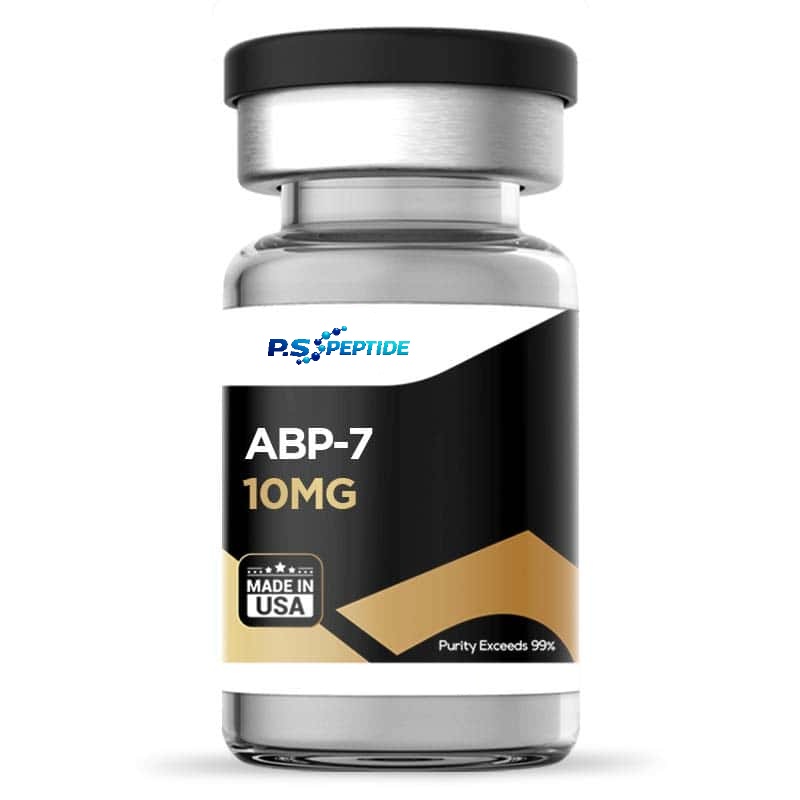
ABP-7 (10mg)
Original price was: $92.00.$90.00Current price is: $90.00.
Size: 10mg
Contents: ABP-7
Form: Lyophilized powder
Purity: >99%
FREE Shipping on $200+ orders
| Title | Range | Discount |
|---|---|---|
| 10% Off | 3 - 6 | 10% |
| 15% Off | 7 + | 15% |
Description
ABP-7 Peptide (Actin Binding Peptide-7)
Promote Wound Healing, Tissue Repair, and Angiogenesis
ABP-7 Peptide, also known as TB-500 Fragment, is a synthetic heptapeptide with the sequence Acetyl-LKKTETQ. Derived from Thymosin Beta 4, ABP-7 is recognized for its potential to enhance actin dynamics, support cellular migration, and promote tissue repair. Researchers consider its LKKTETQ sequence the central actin-binding domain, which may stabilize monomeric actin (G-actin) and influence cytoskeletal structure. Consequently, ABP-7 is being explored for wound healing, angiogenesis, and tissue regeneration studies.
How ABP-7 Peptide Works
ABP-7 may modulate cellular architecture by preventing the polymerization of G-actin into filamentous actin (F-actin). This action can enhance cell motility, shape adaptation, and intracellular transport. By influencing cytoskeletal organization, ABP-7 may promote migration of epidermal and endothelial cells, accelerate wound closure, and support collagen deposition. Moreover, it may stimulate key signaling pathways, including MAP kinases, which regulate proliferation and migration.
Research Applications
Wound Healing and Tissue Repair
Studies indicate ABP-7 may enhance keratinocyte migration, accelerate collagen deposition, and improve wound closure in aged models. By mimicking Thymosin Beta 4’s active domain, ABP-7 potentially facilitates the repair of damaged tissues efficiently.
Anti-Fibrotic Potential
ABP-7 may influence hepatic stellate cells and limit fibrotic activity by modulating PDGF-BB signaling, reducing α-SMA expression, and regulating collagen type I deposition. These mechanisms suggest a possible role in mitigating liver fibrosis and other fibrotic conditions.
Angiogenesis Support
Research suggests ABP-7 may enhance endothelial cell migration, tube formation, and vascular sprouting. By regulating actin availability in endothelial cells, it may support angiogenic processes, contributing to tissue regeneration and vascular health.
Chemical Makeup
-
Molecular Formula: C38H81N9O20
-
Molecular Weight: 889.5 g/mol
-
Other Names: TB-500 Fragment, Ac-LKKTETQ
visit our Contact page for any inquiry
References:
- Esposito, S., Deventer, K., Goeman, J., Van der Eycken, J., & Van Eenoo, P. (2012). Synthesis and characterization of the N-terminal acetylated 17-23 fragment of thymosin beta 4 identified in TB-500, a product suspected to possess doping potential. Drug testing and analysis, 4(9), 733–738. https://doi.org/10.1002/dta.1402
- Sosne, G., Qiu, P., Goldstein, A. L., & Wheater, M. (2010). Biological activities of thymosin beta4 defined by active sites in short peptide sequences. FASEB journal : official publication of the Federation of American Societies for Experimental Biology, 24(7), 2144–2151. https://doi.org/10.1096/fj.09-142307
Reviews
There are no reviews yet.