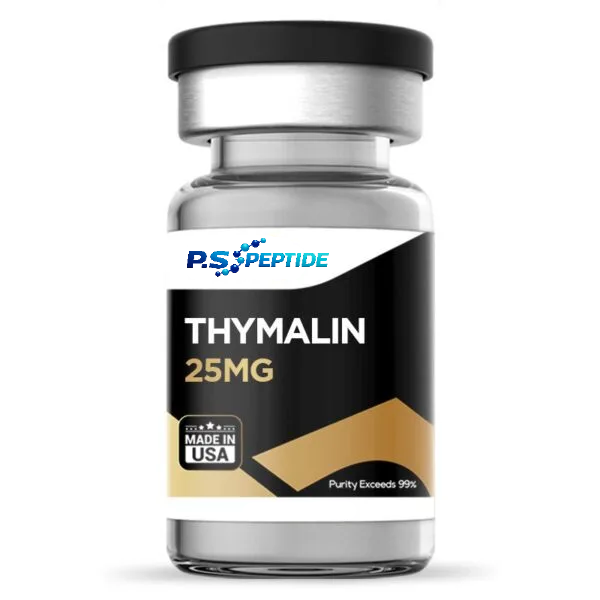
Thymalin (25mg)
Original price was: $138.00.$130.00Current price is: $130.00.
Size: 25mg
Contents: Thymalin (25mg)
Form: Lyophilized powder
Purity: >99%
FREE Shipping on $200+ orders
| Title | Range | Discount |
|---|---|---|
| 10% Off | 3 - 6 | 10% |
| 15% Off | 7 + | 15% |
Description
Thymalin Peptide: Immune Support and Geroprotective Benefits
What is Thymalin?
Thymalin is a polypeptide derived from the thymus gland that helps regulate immune functions. It is primarily found in young thymic cells but decreases with age, becoming thinner and less uniform over time.
Natural thymic peptides like Thymalin were first isolated using mild acid extraction. Researchers identified the active dipeptide L-Glu-L-Trp, which may play a crucial role in its mechanism. While Thymalin regulates thymic functions, Thymulin—a zinc-dependent nonapeptide hormone—enhances T-cell activity.
Key Mechanism
Thymalin and its synthetic analogs, Thymogen and Vilon, stimulate thymic activity, including:
-
Differentiation of T-cells
-
Cytokine production
-
Lymphocyte secretion
Thymalin may also promote antioxidant responses, reducing oxidative stress and indirectly controlling inflammation. This broader activity sets it apart from its synthetic counterparts.
Chemical Makeup
-
Molecular Formula: C33H54N12O15
-
Molecular Weight: 858.864 g/mol
-
Other Names: Thymulin, Thymic Factor
Research and Clinical Studies
Thymalin and Cancer Prevention
A study on 76 female rats tested Thymalin’s effect on tumor development and survival. Rats receiving Thymalin lived longer (average 1048 days vs. 949 days in controls). Tumor incidence decreased by 1.5x, with hematopoietic cancer rates 3.4x lower. Thymalin may enhance T-cell differentiation, neutrophil chemotaxis, and phagocytosis, improving immune response.
Thymalin and Viral Infections
In a study on 50 subjects with HHV-1, Thymalin treatment elevated CD4+ and CD8+ cytokines, enhancing antiviral Th1 responses. Levels of immune exhaustion markers PD-1 and PD-L1 decreased, preventing viral reactivation without affecting IL-4 or IL-10.
Thymalin and Toxic Goiter
It reduced symptoms of Diffuse Toxic Goiter (DTG) in a clinical study of 104 subjects, especially when combined with other compounds. It also lowered lipid oxidation and balanced medium-weight peptides in the bloodstream.
Thymalin and Lympholeukemia
In chronic lymphoid leukemia, Thymalin combined with plasmapheresis improved immune function faster than chemotherapy alone, supporting immune recovery in patients.
Geroprotective Effects
A long-term study with 266 mature subjects explored Thymalin and Epithalamin over 6–8 years. Results suggested improved cardiovascular, neurological, and immunological function, along with enhanced metabolism and hemostasis. It may restore thymic function, improve T-cell quantity and function, reduce systemic inflammation, and modulate cortisol levels. Metabolic parameters, including glucose and lipid profiles, also showed improvement.
Conclusion
Thymalin peptide supports immune function, viral defense, cancer prevention, thyroid health, and geroprotection. Its broad biological effects make it a promising candidate for research and therapeutic applications.
Please review and adhere to our Terms and Conditions before ordering.
References:
- Disorders of the Immune system. https://www.hopkinsmedicine.org/health/conditions-and-diseases/disorders-of-the-immune-system
- Khavinson VK, Linkova NS, Kvetnoy IM, Polyakova VO, Drobintseva AO, Kvetnaia TV, Ivko OM. Thymalin: Activation of Differentiation of Human Hematopoietic Stem Cells. Bull Exp Biol Med. 2020 Nov;170(1):118-122. doi: 10.1007/s10517-020-05016-z. Epub 2020 Nov 25. https://pubmed.ncbi.nlm.nih.gov/33237528/
- Remien K, Jan A. Anatomy, Head and Neck, Thymus. [Updated 2021 Feb 9]. In: StatPearls [Internet]. Treasure Island (FL): StatPearls Publishing. https://www.ncbi.nlm.nih.gov/books/NBK539748/
Reviews
There are no reviews yet.