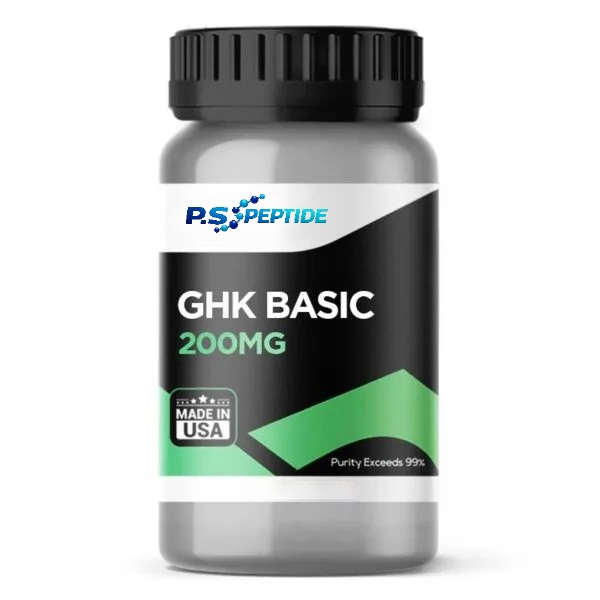
GHK Basic (Tripeptide-1) (200mg)
$155.00
Size: 200mg
Contents: GHK Basic (Tripeptide-1)
Form: Lyophilized powder
Purity: >99%
FREE Shipping on $200+ orders
| Title | Range | Discount |
|---|---|---|
| 10% Off | 3 - 6 | 10% |
| 15% Off | 7 + | 15% |
Description
GHK-Cu (Tripeptide-1): Peptide for Skin Repair, Collagen, and Anti-Aging
GHK-Cu, also known as glycyl-L-histidyl-L-lysine or Tripeptide-1, is a naturally occurring tripeptide found in plasma, saliva, and other body fluids. It binds copper ions and plays a key role in wound healing, tissue repair, and collagen production. The peptide is produced by fibroblasts, lymphocytes, and macrophages, and it regulates gene expression, enzymes, ion channels, and cellular repair processes.
GHK-Cu levels decline with age, which may contribute to impaired tissue regeneration, wrinkles, and decreased immune function. Research suggests that supplementing with GHK-Cu may boost collagen and elastin production, stimulate glycosaminoglycans, and improve skin thickness, hydration, and elasticity.
Chemical Makeup
-
Molecular Formula: C14H24N6O4
-
Molecular Weight: 340.4 g/mol
-
Other Names: Glycyl-L-histidyl-L-lysine, Copper peptide, Tripeptide 1, NSC 379527
Research and Clinical Insights
GHK-Cu and Wound Healing
Studies show that GHK-Cu may accelerate wound closure and enhance tissue repair:
-
In diabetic ulcer models, GHK-Cu increased ulcer closure and lowered infection rates (7% vs 34% for controls).
-
In animal models, wounds treated with GHK-Cu showed higher neutrophil and vessel counts, improved vascularization, and enhanced granulation tissue formation.
-
Collagen-enriched dressings with GHK-Cu led to near-complete wound closure (~99%) compared to 69% in controls, also improving antioxidant levels and epithelialization.
GHK-Cu and Skin Cells
GHK-Cu supports skin rejuvenation by stimulating:
-
Collagen type I synthesis – critical for skin strength and wrinkle reduction.
-
Elastin and glycosaminoglycans – for elasticity and ECM integrity.
-
Fibroblast proliferation – accelerating ECM regeneration.
-
Keratinocyte activity – improving epidermal health, hydration, and thickness.
Clinical studies suggest that GHK-Cu may improve post-laser resurfacing recovery, enhance skin texture, and reduce the appearance of fine lines and wrinkles.
GHK-Cu and Anti-Inflammation
It exhibits anti-inflammatory effects by:
-
Reducing pro-inflammatory cytokines such as TNF-alpha, IL-6, and MMP-2/9.
-
Inhibiting NF-κB and p38 MAPK pathways, lowering tissue inflammation.
-
Protecting against oxidative stress by scavenging free radicals from lipid peroxidation (e.g., 4-HNE, MDA, acrolein).
-
Limiting iron release from ferritin by up to 87%, reducing oxidative tissue damage.
GHK-Cu and Antioxidant Protection
Research shows that GHK-Cu may:
-
Upregulate Nrf2, enhancing antioxidant defenses in skin and lung tissues.
-
Reduce reactive oxygen species more effectively than carnosine or glutathione.
-
Protect cells from UV damage and oxidative stress, supporting anti-aging and skin renewal.
Key Benefits of GHK-Cu
-
Accelerates wound healing and tissue repair
-
Stimulates collagen and elastin production
-
Improves skin thickness, hydration, and elasticity
-
Reduces inflammation and oxidative stress
-
Supports anti-aging and wrinkle reduction
Please review and adhere to our Terms and Conditions before ordering.
References:
- Mulder, G. D., Patt, L. M., Sanders, L., Rosenstock, J., Altman, M. I., Hanley, M. E., & Duncan, G. W. (1994). Enhanced healing of ulcers in patients with diabetes by treatment with glycyl-l-histidyl-l-lysine copper. Wound repair and regeneration : official publication of the Wound Healing Society [and] the European Tissue Repair Society, 2(4), 259–269. https://doi.org/10.1046/j.1524-475X.1994.20406.x
- Gul, N. Y., Topal, A., Cangul, I. T., & Yanik, K. (2008). The effects of tripeptide copper complex and helium-neon laser on wound healing in rabbits. Veterinary dermatology, 19(1), 7–14. https://doi.org/10.1111/j.1365-3164.2007.00647.x
Related products
-
Decapeptide-12 (200mg)
$230.00 Add to cart -
Sale!
SNAP-8 (200mg)
Original price was: $195.00.$175.00Current price is: $175.00. Add to cart -
Pal-GHK (200mg)
$175.00 Add to cart -
NAD+ Peptide (100mg / 250mg / 750mg)
Price range: $45.00 through $290.00 Select options This product has multiple variants. The options may be chosen on the product page
Reviews
There are no reviews yet.