
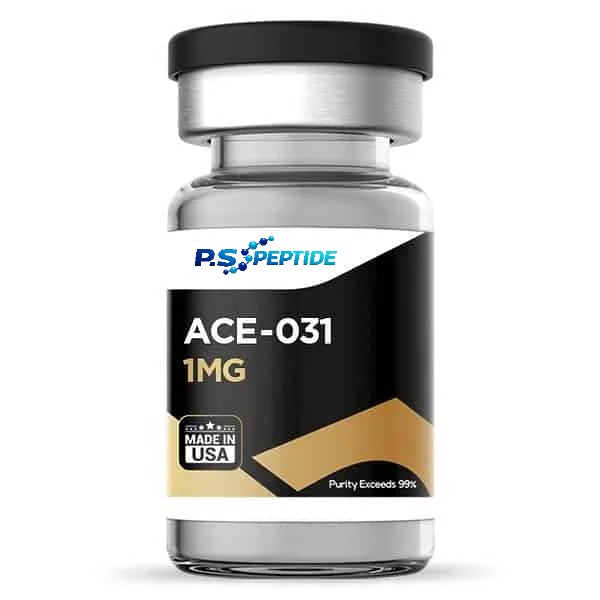
ACE-031 (1mg)
Original price was: $173.00.$170.00Current price is: $170.00.
Size: 1mg
Contents: ACE-031 (1mg)
Form: Lyophilized powder
Purity: >99%
FREE Shipping on $200+ orders
| Title | Range | Discount |
|---|---|---|
| 10% Off | 3 - 6 | 10% |
| 15% Off | 7 + | 15% |
Description
ACE-031 Peptide (CE-031): Myostatin Inhibition for Muscle Growth and Metabolic Support
ACE-031, also known as ActRIIB-IgG1 peptide or soluble activin type IIB receptor (ActRIIB-IgG1-Fc), is a synthetic peptide that functions as a myostatin inhibitor. It is a fusion compound combining the activin receptor type IIB (ACV2RB) and a recombinant IgG1 Fc antibody, which allows it to circulate in the bloodstream and target specific growth factors.
Myostatin, or GDF8, is a negative regulator of skeletal muscle growth. It binds to ACV2RB receptors, activating a signaling cascade through Smad2/3, which limits muscle hypertrophy. ACE-031 appears to block circulating myostatin and other ligands from the TGF-β superfamily, keeping the ACV2RB receptors available. As a result, skeletal muscle growth is promoted, potentially enhancing muscle mass, metabolism, and bone density without affecting cardiac or smooth muscle.
Chemical Composition of ACE-031
-
Molecular Formula: C₃₄₁₈H₅₁₈₈N₉₂₈O₁₀₆₂S₃₈
-
Molecular Weight: 77,489.82 g/mol
-
Other Names: ActRIIB-IgG1 peptide, soluble activin type IIB receptor
Research and Clinical Insights
ACE-031 and Muscle Hypertrophy
In double-blind, placebo-controlled studies, ACE-031 demonstrated significant muscle growth. After 29 days, participants exhibited a 3.3% increase in total body lean mass and a 5.1% increase in quadriceps volume, measured using DXA and MRI. Serum biomarkers also suggested enhanced bone and fat metabolism, reflecting the peptide’s potential systemic benefits.
ACE-031 and Fat Metabolism
Research indicates that myostatin overexpression in obesity models correlates with decreased muscle mass and increased fat accumulation. ACE-031 may counteract these effects by:
-
Upregulating lipolysis and fatty acid oxidation enzymes (e.g., CPT1a, CPT2), enhancing energy use and reducing lipid storage.
-
Promoting brown/beige fat formation, converting energy-storing white fat into thermogenic fat that burns calories.
Animal studies show ACE-031 may reduce obesity phenotypes and limit fat accumulation under high-calorie diets.
ACE-031 and Muscle Contractile Force
ACE-031 may improve muscle performance beyond hypertrophy. Studies in murine models report:
-
33% increase in muscle volume without altering fiber type distribution
-
22% rise in basal oxygen consumption
-
23% increase in energy expenditure
-
Enhanced maximum and total contractile force by 40% and 24%, respectively
These effects suggest ACE-031 may optimize metabolic and contractile functions of skeletal muscles.
ACE-031 and Bone Density
In murine models of Duchenne Muscular Dystrophy, ACE-031 increased femoral bone volume by ~80% and trabecular number by +70%. Vertebral bone mass also increased by 20–30%. Histological studies reported fewer osteoclasts and higher expression of osteoblast marker genes, indicating improved bone formation and reduced resorption. Biomechanical testing confirmed increased bone strength and stiffness, highlighting ACE-031’s potential for skeletal support.
Please review and adhere to our Terms and Conditions before ordering.
References:
- Campbell C, McMillan HJ, Mah JK, Tarnopolsky M, Selby K, McClure T, Wilson DM, Sherman ML, Escolar D, Attie KM. Myostatin inhibitor ACE-031 treatment of ambulatory boys with Duchenne muscular dystrophy: Results of a randomized, placebo-controlled clinical trial. Muscle Nerve. 2017 Apr;55(4):458-464. https://pubmed.ncbi.nlm.nih.gov/27462804/
- McPherron AC, Lawler AM, Lee SJ. Regulation of skeletal muscle mass in mice by a new TGF-beta superfamily member. Nature. 1997 May 1;387(6628):83-90. https://pubmed.ncbi.nlm.nih.gov/9139826/
- Attie KM, Borgstein NG, Yang Y, Condon CH, Wilson DM, Pearsall AE, Kumar R, Willins DA, Seehra JS, Sherman ML. A single ascending-dose study of muscle regulator ACE-031 in healthy volunteers. Muscle Nerve. 2013 Mar;47(3):416-23. https://pubmed.ncbi.nlm.nih.gov/23169607/
Reviews
There are no reviews yet.