
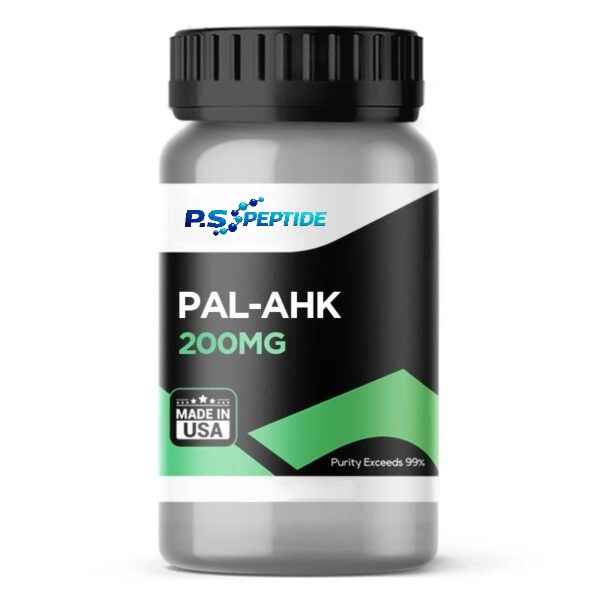
Pal-AHK (200mg)
$175.00
Size: 200mg
Contents: Pal-AHK
Form: Lyophilized powder
Purity: >99%
FREE Shipping on $200+ orders
| Title | Range | Discount |
|---|---|---|
| 10% Off | 3 - 6 | 10% |
| 15% Off | 7 + | 15% |
Description
Pal-AHK Peptide: Research Overview and Potential Skin & Hair Benefits
Pal-AHK is a synthetic peptide composed of alanine, histidine, and lysine, enhanced with a palmitoyl group. Although current studies focus mainly on the non-palmitoylated form (AHK), researchers believe Pal-AHK likely produces similar biological effects. Importantly, palmitoylation generally improves cell and skin penetration, which may enhance the peptide’s effectiveness without altering its core mechanism of action.
Research suggests that AHK and Pal-AHK may stimulate the production of collagen and elastin, two proteins that play a critical role in the skin’s extracellular matrix (ECM). Collagen provides strength and structural support, while elastin maintains elasticity. Therefore, supporting both proteins may help improve skin firmness and resilience.
In addition, Pal-AHK may exhibit antioxidant activity. Oxidative stress damages cells through free radicals and contributes to visible aging. By neutralizing these free radicals, antioxidants may help limit environmental damage, reduce wrinkle depth, and protect skin integrity. Furthermore, preliminary research suggests Pal-AHK may influence hair follicle health through antioxidant pathways and interactions with growth factors involved in cell survival and angiogenesis.
Chemical Composition of Pal-AHK
-
Molecular Formula: C₃₁H₅₆N₆O₅
-
Molecular Weight: 592.8 g/mol
-
Also Known As: Palmitoyl AHK
Research and Clinical Insights
Pal-AHK Peptide and Antioxidant Activity
Researchers originally derived the tripeptide AHK from albumin hydrolysate. When combined with a palmitoyl group, the peptide may penetrate skin cells more effectively. Studies suggest that AHK may reduce the expression of transforming growth factor-β1 (TGF-β1), a molecule involved in inflammation, extracellular matrix regulation, and angiogenesis.
While TGF-β1 supports tissue repair, excessive activity may contribute to chronic inflammation and tissue damage. Therefore, moderating TGF-β1 levels may help protect skin cells. Additionally, researchers attribute the antioxidant potential of Pal-AHK to its amino acid composition. In laboratory studies, AHK appeared to increase dermal cell viability and proliferation, which may indirectly support collagen production and ECM renewal.
Pal-AHK Peptide and Hair Follicle Support
Direct studies on Pal-AHK and hair growth remain limited. However, research on AHK derivatives suggests that similarly structured peptides may promote hair follicle growth by stimulating dermal papilla cell (DPC) proliferation and reducing apoptosis.
Researchers propose that Pal-AHK may increase the Bcl-2/Bax ratio, which favors cell survival. Bcl-2 inhibits programmed cell death, while Bax promotes it. Consequently, a higher Bcl-2/Bax ratio may help preserve dermal papilla cells that are essential for hair growth.
Moreover, studies suggest that AHK-related peptides may reduce the activity of cleaved caspase-3 and PARP, both key drivers of apoptosis. By limiting these apoptotic markers, Pal-AHK may help maintain follicle viability. In addition, researchers report that Pal-AHK may increase vascular endothelial growth factor (VEGF) expression. Since VEGF supports blood vessel formation around hair follicles, increased VEGF may improve nutrient delivery and support hair retention and growth.
Pal-AHK Peptide and Skin Cell Function
Although reducing TGF-β1 often produces antiproliferative effects, researchers suggest Pal-AHK may stimulate skin cell growth through alternative pathways. While studies on Pal-AHK itself remain limited, laboratory research on AHK provides promising insights.
Cell culture studies using normal dermal fibroblasts indicate that AHK increased cell viability and proliferation. More importantly, researchers observed a significant rise in type I collagen production, with reports of up to a 300% increase compared to control groups. Since fibroblasts drive ECM protein synthesis, these findings suggest that AHK—and by extension Pal-AHK—may support extracellular matrix renewal and skin regeneration.
Please review and adhere to our Terms and Conditions before ordering.
References:
- Tsuge, N., Eikawa, Y., Nomura, Y., Yamamoto, M., & Sugisawa, K. (1991). The anti-oxidative activity of peptides prepared by enzymatic hydrolysis of egg-white albumin. Journal of the Agricultural Chemical Society of Japan.
- Shimura, H., Tanaka, R., Shimada, Y., Yamashiro, K., Hattori, N., & Urabe, T. (2017). Glycyl-alanyl-histidine protects PC12 cells against hydrogen peroxide toxicity. BMC biochemistry, 18(1), 14. https://doi.org/10.1186/s12858-017-0089-x
- Nirmal, B. (2018). Key MessAges. IADVL Textbook of Trichology, 163.
Related products
-
BPC-157 & TB-500 & GHK-Cu Blend (70mg)
$300.00 Add to cart -
Decapeptide-12 (200mg)
$230.00 Add to cart -
AHK-Cu Peptide (200mg)
$203.00 Add to cart -
NAD+ Peptide (100mg / 250mg / 750mg)
Price range: $45.00 through $290.00 Select options This product has multiple variants. The options may be chosen on the product page
Reviews
There are no reviews yet.