
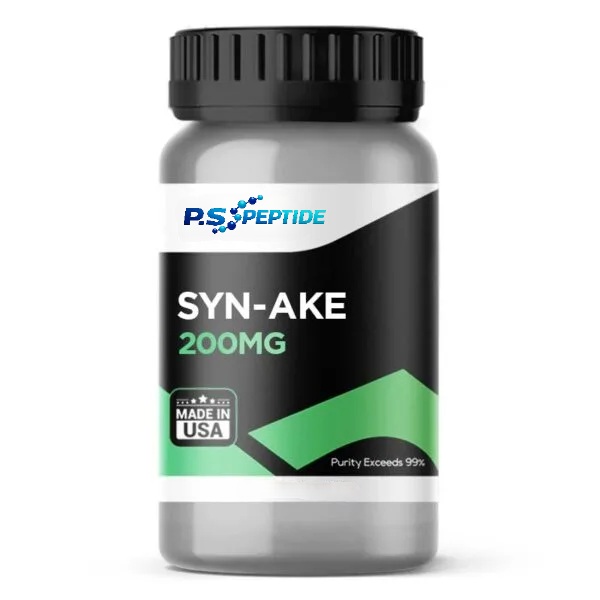
Syn-AKE (200mg)
$175.00
Size: 200mg
Contents: Syn-AKE
Form: Lyophilized powder
Purity: >99%
FREE Shipping on $200+ orders
| Title | Range | Discount |
|---|---|---|
| 10% Off | 3 - 6 | 10% |
| 15% Off | 7 + | 15% |
Description
Syn-AKE Peptide: Mechanism, Research, and Anti-Wrinkle Potential
Syn-AKE is a synthetic peptide also known as tripeptide-3. Its structure consists of alanine, proline, and diamino butyrate linked by peptide bonds. Researchers developed Syn-AKE to mimic the activity of Waglerin-1, a naturally occurring muscle-relaxant polypeptide.
Waglerin-1 reduces muscle contractions by blocking acetylcholine activity at the neuromuscular junction. Similarly, Syn-AKE was designed to temporarily inhibit muscle contractions beneath the skin. As a result, this peptide may help reduce wrinkle depth, soften expression lines, and improve overall skin texture.
Because of its muscle-relaxing properties, researchers have extensively studied Syn-AKE for potential cosmetic and anti-aging applications. These studies focus on its ability to minimize fine lines, enhance skin smoothness, and support skin hydration.
Chemical Composition of Syn-AKE
-
Molecular Formula: C₂₃H₃₇N₅O₇
-
Molecular Weight: 495.57 g/mol
-
Also Known As: Tripeptide-3, Syn-AKE acetate, SYN-AK, DTXSID40231699, EX-A3743
Research and Clinical Insights
Syn-AKE Peptide Mechanism of Action
Research suggests that Syn-AKE closely mimics the activity of Waglerin-1 while avoiding its neurological risks. Waglerin-1 selectively targets nicotinic acetylcholine receptors (nAChRs), which transmit signals from nerve cells to muscle fibers. When acetylcholine binds to these receptors, muscle contraction occurs.
By contrast, Syn-AKE appears to bind to the same nAChRs in the neuromuscular junction. Consequently, it may block acetylcholine signaling and reduce muscle contractions. Unlike Waglerin-1, however, Syn-AKE does not appear to interact with GABA receptors in the brain, which may lower potential risks in cosmetic research settings.
Additionally, researchers believe Syn-AKE exhibits strong skin permeability. After penetrating the epidermis, it may reach underlying muscle tissue and temporarily prevent nAChRs from responding to acetylcholine. Therefore, Syn-AKE may be particularly effective against dynamic expression lines caused by repetitive facial movements.
Experimental studies report that Syn-AKE reduced the frequency of innervated muscle cell contractions by up to 82% within two hours of application. Importantly, this antagonistic activity appears to be reversible, indicating that its effects are temporary and diminish once the peptide is no longer present.
Syn-AKE Peptide and Fine Lines, Wrinkles
Clinical research suggests that Syn-AKE may provide both immediate and long-term wrinkle reduction. According to multiple studies, the peptide appears to minimize muscle contraction shortly after application, leading to visible smoothing of fine lines.
In a three-month study involving 37 women aged 33 to 45 with mild-to-moderate wrinkles, researchers observed statistically significant wrinkle improvement immediately after use and again at one- and three-month evaluations. These findings suggest cumulative benefits with consistent application.
Furthermore, one of the largest comparative studies evaluated Syn AKE alongside other peptides and a placebo in 45 participants. Results showed that this peptide gradually increased effectiveness over time. After four weeks, researchers reported over 50% improvement, with up to a 52% reduction in wrinkle size following twice-daily application of a 4% formulation to the forehead.
Please review and adhere to our Terms and Conditions before ordering.
References:
- Balaev, A. N., Okhmanovich, K. A., & Osipov, V. N. (2014). A shortened, protecting group free, synthesis of the anti-wrinkle venom analogue Syn-Ake exploiting an optimized Hofmann-type rearrangement. Tetrahedron Letters, 55(42), 5745-5747.
- Molles, B. E., Tsigelny, I., Nguyen, P. D., Gao, S. X., Sine, S. M., & Taylor, P. (2002). Residues in the epsilon subunit of the nicotinic acetylcholine receptor interact to confer selectivity of waglerin-1 for the alpha-epsilon subunit interface site. Biochemistry, 41(25), 7895–7906. https://doi.org/10.1021/bi025732d
- Gorouhi, F., & Maibach, H. I. (2009). Role of peptides in preventing or treating aged skin. International journal of cosmetic science, 31(5), 327–345. https://doi.org/10.1111/j.1468-2494.2009.00490.x
- Reddy, B., Jow, T., & Hantash, B. M. (2012). Bioactive oligopeptides in dermatology: Part I. Experimental dermatology, 21(8), 563–568. https://doi.org/10.1111/j.1600-0625.2012.01528.x
Related products
-

Vialox (Pentapeptide-3V) (200mg)
$175.00 Add to cart -
Sale!
Humanin (10mg)
Original price was: $147.00.$145.00Current price is: $145.00. Add to cart -
NAD+ Peptide (100mg / 250mg / 750mg)
Price range: $45.00 through $290.00 Select options This product has multiple variants. The options may be chosen on the product page -
Sale!
ACE-031 (1mg)
Original price was: $173.00.$170.00Current price is: $170.00. Add to cart
Reviews
There are no reviews yet.