
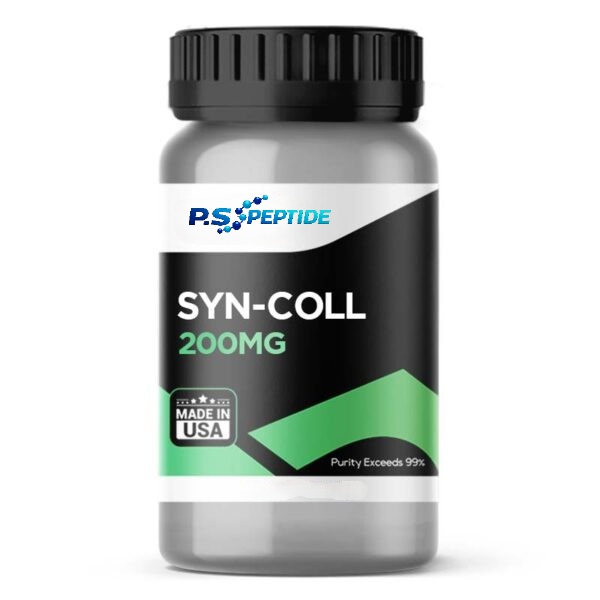
Syn-Coll (Palmitoyl Tripeptide-5) (200mg)
$175.00
Size: 200mg
Contents: Syn-COLL
Form: Lyophilized powder
Purity: >99%
FREE Shipping on $200+ orders
| Title | Range | Discount |
|---|---|---|
| 10% Off | 3 - 6 | 10% |
| 15% Off | 7 + | 15% |
Description
Syn-Coll Peptide: Mechanism, Research, and Potential Skin Benefits
Syn-Coll is a synthetic peptide also known as palmitoyl tripeptide-5. Scientists designed this compound to mimic the biological activity of thrombospondin-1 (TSP-1), a naturally occurring extracellular matrix protein. TSP-1 plays a key role in activating transforming growth factor beta (TGF-β), a growth factor essential for maintaining skin structure and stimulating collagen synthesis.
Because TGF-β regulates postnatal skin development, its activation supports the production of new collagen fibers. As a result, Syn-Coll has gained attention for its potential role in improving skin firmness and integrity.
The short amino acid sequence Lys-Arg-Phe-Lys in TSP-1 appears responsible for TGF-β stimulation. Although Syn-Coll uses a different sequence—Palmitoyl-Lys-Val-Lys—researchers report that it may trigger similar biological effects. Consequently, animal models and dermal fibroblast studies suggest that Syn-Coll may increase collagen synthesis, particularly Type I and Type III collagen.
Furthermore, studies indicate that Syn-Coll may not only promote collagen production but also reduce collagen degradation. Specifically, researchers propose that it may inhibit matrix metalloproteinases (MMPs), including MMP-1 and MMP-3, which are enzymes known to break down collagen.
Chemical Composition of Syn-Coll
-
Molecular Formula: C₃₃H₆₅N₅O₅
-
Molecular Weight: 611.9 g/mol
-
Also Known As: Palmitoyl-lysyl-valyl-lysine, Palmitoyl Tripeptide-5
Research and Clinical Insights
Syn-Coll and Collagen Synthesis
Collagen represents a major structural component of the extracellular matrix, which supports dermal connective tissue. Recent research suggests that Syn-Coll may stimulate collagen synthesis by activating TGF-β. More specifically, it appears to mimic a functional segment of TSP-1, thereby initiating a signaling cascade that enhances collagen gene expression.
Once activated, TGF-β may increase the production of Type I and Type III collagen as well as fibronectin in dermal fibroblasts. As a result, scientists report sustained elevations in collagen-related mRNA levels. Notably, comparative studies indicate that Syn-Coll may stimulate Type I collagen production up to 60% more effectively than peptides such as palmitoyl pentapeptide.
Syn-Coll and Collagen Breakdown
Matrix metalloproteinases play a critical role in extracellular matrix remodeling. However, excessive MMP activity may accelerate collagen degradation and contribute to visible skin aging. For example, MMP-1 primarily degrades Type I collagen, while MMP-3 targets a broad range of structural proteins, including Type III collagen.
Research suggests that Syn-Coll may reduce collagen breakdown by inhibiting the activity of MMP-1 and MMP-3. Therefore, by both stimulating collagen synthesis and limiting enzymatic degradation, Syn-Coll may help preserve dermal structure and resilience.
Syn-Coll and Anti-Aging Potential
Clinical studies further suggest that Syn-Coll may visibly reduce wrinkle appearance. In controlled trials, formulations containing Syn-Coll demonstrated dose-dependent wrinkle reduction measured using PRIMOS surface topography. Ultimately, researchers concluded that Syn-Coll showed approximately 3.5 times greater wrinkle-reduction potential than placebo.
In a separate 84-day study involving 60 participants, twice-daily application resulted in reduced skin roughness and a 12% improvement in wrinkle parameters compared to control and placebo groups.
Beyond collagen modulation, Syn-Coll may support anti-aging through additional mechanisms. For instance, it may help strengthen the skin barrier by reducing transepidermal water loss. Additionally, it may function as a humectant, supporting moisture retention, while also increasing surface lipids and acting as an emollient.
Moreover, researchers have explored a modified version of Syn-Coll conjugated with L-ascorbate (Pal-KVK-AA). This variation may inhibit melanin synthesis and potentially reduce hyperpigmentation linked to photoaging, UV exposure, and oxidative stress.
Please review and adhere to our Terms and Conditions before ordering.
References:
- Murphy-Ullrich, J. E., & Poczatek, M. (2000). Activation of latent TGF-beta by thrombospondin-1: mechanisms and physiology. Cytokine & growth factor reviews, 11(1-2), 59–69. https://doi.org/10.1016/s1359-6101(99)00029-5
- Trookman, N. S., Rizer, R. L., Ford, R., Ho, E., & Gotz, V. (2009). Immediate and Long-term Clinical Benefits of a Treatment for Facial Lines and Wrinkles. The Journal of clinical and aesthetic dermatology, 2(3), 38–43.
- Varga, J., Rosenbloom, J., & Jimenez, S. A. (1987). Transforming growth factor beta (TGF beta) causes a persistent increase in steady-state amounts of type I and type III collagen and fibronectin mRNAs in normal human dermal fibroblasts. The Biochemical journal, 247(3), 597–604. https://doi.org/10.1042/bj2470597
- Bucay, V. W., & Day, D. (2013). Adjunctive skin care of the brow and periorbital region. Clinics in plastic surgery, 40(1), 225–236. https://doi.org/10.1016/j.cps.2012.09.003
Reviews
There are no reviews yet.