
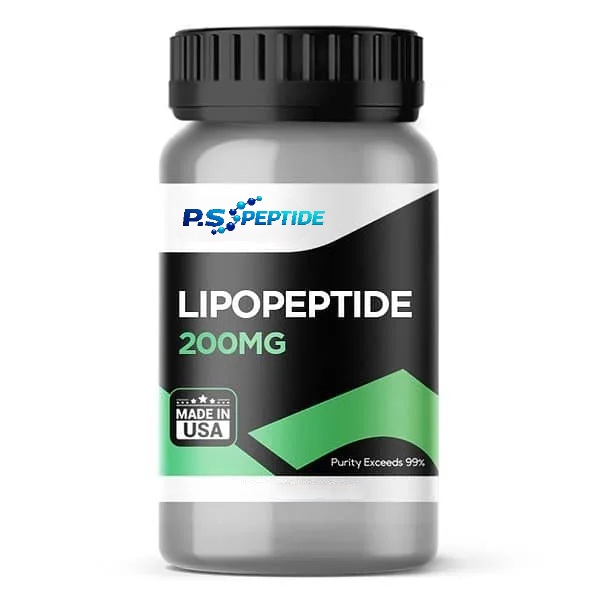
Lipopeptide (200mg)
$210.00
Size: 200mg
Contents: GHK-Cu
Form: Lyophilized powder
Purity: >99%
FREE Shipping on $200+ orders
| Title | Range | Discount |
|---|---|---|
| 10% Off | 3 - 6 | 10% |
| 15% Off | 7 + | 15% |
Description
Lipopeptide Peptide
Overview
Lipopeptide is a palmitoylated peptide characterized by the sequence Palmitoyl-Gly-Gln-Pro-Arg (Pal-GQPR). Researchers derived this peptide fragment from immunoglobulin G (IgG), a class of antibodies that plays a significant role in immune and inflammatory responses.
Through palmitoylation, scientists attach a palmitic acid molecule to the peptide. This lipid modification appears to enhance the peptide’s experimental properties. In particular, it may improve penetration through the lipid-rich outer layers of skin tissue models. As a result, researchers frequently investigate Lipopeptide in studies related to skin structure, inflammation, and tissue integrity.
Chemical Properties
-
Molecular Formula: C₃₈H₆₈N₆O₈
-
Molecular Weight: 736.9 g/mol
-
Amino Acid Sequence: Pal-Gly-Gln-Pro-Arg
-
Also Known As: Pal-GQPR, Palmitoyl Tetrapeptide-7/3
Research and Experimental Findings
Extracellular Dermal Matrix Research
Several studies have examined Lipopeptide as part of peptide blends targeting skin cell structure. Echography assessments suggested a possible reduction in the thickness of the subepidermal low-echogenic band, alongside increased density. These observations may indicate an improvement in overall skin structure.
Additionally, murine studies suggested that Lipopeptide-containing formulations may enhance extracellular dermal matrix organization when compared to placebo. Researchers also proposed that Lipopeptide may reduce the secretion of interleukin-6 (IL-6), a cytokine commonly associated with inflammatory responses. Since IL-6 levels often rise following UVB exposure, this reduction may be relevant in studies of inflammation-related skin damage.
Moreover, researchers observed potential stimulation of key structural proteins surrounding skin cells. These include laminin IV, laminin V, and collagen VII. Laminins support basement membrane integrity and assist with cell adhesion and migration. Meanwhile, collagen VII contributes to anchoring fibrils that stabilize the connection between the epidermis and dermis. Together, these findings suggest a possible role for Lipopeptide in supporting the skin’s structural framework.
Other researchers have also described Lipopeptide as having potential anti-inflammatory, skin-firming, and anti-aging research relevance.
Photoaged Skin Cell Studies
Researchers further evaluated Lipopeptide in randomized controlled trials as part of multi-ingredient formulations. These studies focused on photoaged skin models and included additional compounds such as retinyl palmitate and botanical extracts.
Within 12 days, researchers observed increased deposition of fibrillin-1, a biomarker associated with skin repair, when compared to baseline measurements. Notably, these findings appeared comparable to those observed with all-trans retinoic acid, a commonly referenced standard in photoaging research.
In longer-term trials, researchers reported progressive improvements in wrinkle appearance over six and twelve months. In contrast, vehicle-only formulations did not demonstrate similar changes. Skin biopsies also revealed increased fibrillin-1 distribution within the papillary dermis in treated samples, further supporting potential structural effects. Based on these observations, researchers concluded that Lipopeptide may contribute to visible improvements in photoaged skin models and supports fibrillin-1 as a biomarker for dermal repair.
Please review and adhere to our Terms and Conditions before ordering.
References:
- Mondon, P., Hillion, M., Peschard, O., Andre, N., Marchand, T., Doridot, E., Feuilloley, M. G., Pionneau, C., & Chardonnet, S. (2015). Evaluation of dermal extracellular matrix and epidermal-dermal junction modifications using matrix-assisted laser desorption/ionization mass spectrometric imaging, in vivo reflectance confocal microscopy, echography, and histology: effect of age and peptide applications. Journal of cosmetic dermatology, 14(2), 152–160. https://doi.org/10.1111/jocd.12135
- Resende, D. I. S. P., Ferreira, M. S., Sousa-Lobo, J. M., Sousa, E., & Almeida, I. F. (2021). Usage of Synthetic Peptides in Cosmetics for Sensitive Skin. Pharmaceuticals (Basel, Switzerland), 14(8), 702. https://doi.org/10.3390/ph14080702
- Fadilah, N. I. M., Rahman, M. B. A., Yusof, L. M., Mustapha, N. M., & Ahmad, H. (2021). The Therapeutic Effect and In Vivo Assessment of Palmitoyl-GDPH on the Wound Healing Process. Pharmaceutics, 13(2), 193. https://doi.org/10.3390/pharmaceutics13020193
- Watson, R. E., Ogden, S., Cotterell, L. F., Bowden, J. J., Bastrilles, J. Y., Long, S. P., & Griffiths, C. E. (2009). Effects of a cosmetic ‘anti-ageing’ product improves photoaged skin [corrected]. The British journal of dermatology, 161(2), 419–426. https://doi.org/10.1111/j.1365-2133.2009.09216.x
Related products
-

Vialox (Pentapeptide-3V) (200mg)
$175.00 Add to cart -
Nonapeptide-1 (200mg)
$210.00 Add to cart -
BPC-157 & TB-500 & GHK-Cu Blend (70mg)
$300.00 Add to cart -
Sale!
Thymosin Alpha-1 (5mg / 10mg)
Price range: $80.00 through $145.00 Select options This product has multiple variants. The options may be chosen on the product page
Reviews
There are no reviews yet.