
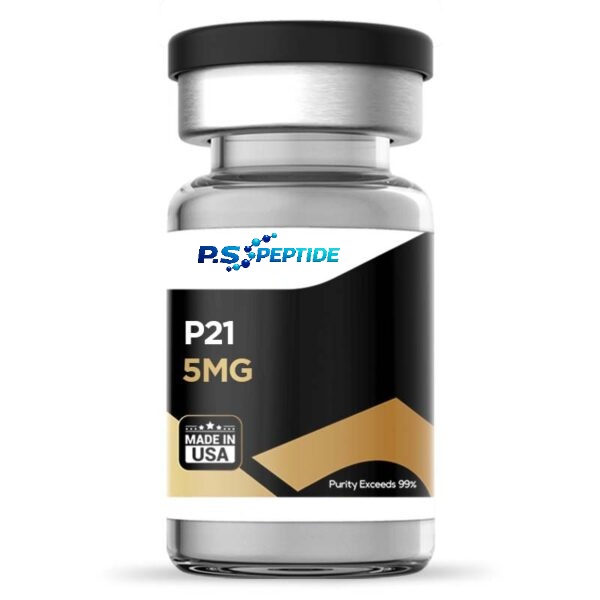
P21 Peptide (5mg)
$115.00
Size: 5mg
Contents: P21
Form: Lyophilized powder
Purity: >99%
FREE Shipping on $200+ orders
| Title | Range | Discount |
|---|---|---|
| 10% Off | 3 - 6 | 10% |
| 15% Off | 7 + | 15% |
Description
P21 Peptide (P021)
Advanced Neurotrophic Research Peptide
P21 Peptide, also known as P021, is a synthetic neurotrophic compound designed to mimic the activity of ciliary neurotrophic factor (CNTF) without triggering immune hypersensitivity. Unlike native CNTF, P21 aims to provide targeted neurotrophic support while maintaining structural stability. Therefore, researchers frequently explore P21 in studies focused on cognition, neurogenesis, and synaptic plasticity.
Scientists developed P21 after identifying active CNTF regions through antibody epitope mapping. Subsequently, they modified a short amino acid fragment and enhanced its stability with adamantane groups. As a result, P21 demonstrates improved resistance to degradation and enhanced blood-brain barrier permeability in experimental models.
How P21 Peptide Works
P21 may activate the CNTF receptor complex and initiate downstream signaling pathways involved in neuronal survival and differentiation. In particular, research models suggest that P21 may:
-
Support hippocampus-dependent learning and memory
-
Promote adult hippocampal neurogenesis
-
Enhance synaptic plasticity
-
Encourage neuronal differentiation
Moreover, P21 appears to influence key neurotrophic markers associated with cognitive function. Because of these interactions, researchers continue to evaluate its role in neurodegenerative and cognitive impairment models.
Chemical Makeup
Molecular Formula: C30H54N6O5
Molecular Weight: 578.3 g/mol
Sequence: Ac-DGGL-adamantanylglycine-NH2
Other Known Title: P021
P21 Peptide Research Applications
P21 and Cognitive Impairment Models
Researchers have extensively studied P21 in experimental cognitive decline models. For example, investigations in 3xTg-AD murine models suggest that P21 may rescue dendritic and synaptic deficits. Additionally, findings indicate increased neurogenesis and improved cognitive performance during synaptic compensation phases.
Importantly, P21 appears to elevate synaptic markers such as:
-
Synapsin
-
PSD-95
-
MAP2
These proteins regulate neurotransmitter release, organize postsynaptic density, and stabilize dendritic structure. Consequently, higher expression levels may support stronger synaptic communication and structural integrity.
Furthermore, studies in aged Fisher murine models suggest that P21 may reduce age-related cognitive decline. Specifically, researchers observed potential increases in brain-derived neurotrophic factor (BDNF) expression. Since BDNF supports neuron survival and dendritic growth, elevated levels may enhance synaptic plasticity and neural connectivity.
P21 and Alzheimer’s Disease (AD) Research Models
P21 continues to attract attention in Alzheimer’s disease research. Several studies indicate that chronic P21 exposure may reduce total tau protein levels in aged models. Additionally, researchers report that P21 crosses the blood-brain barrier without inducing detectable immune responses in experimental settings.
Because tau phosphorylation contributes to neurofibrillary tangle formation, investigators explore whether P21 may influence downstream regulators such as glycogen synthase kinase-3 (GSK-3). Through potential BDNF pathway modulation, P21 may indirectly reduce tau phosphorylation in certain models.
Moreover, transgenic murine studies suggest that early P21 exposure may:
-
Reduce abnormal tau and amyloid-beta accumulation
-
Improve cognitive performance
-
Enhance PSD-95 and CREB signaling
-
Decrease markers of neuroinflammation
In addition, some experiments report activation of signaling cascades such as PLC/PKC, MEK/ERK, and PI3K/Akt. These pathways support neuronal survival, growth, and synaptic plasticity. Therefore, researchers continue exploring P21 as a neurotrophic research candidate in AD-related investigations.
P21 and Macular Degeneration Research
Beyond cognitive studies, scientists also investigate P21 in age-related macular degeneration (AMD) models. Research in aged and 3xTg-AD murine models suggests that consistent P21 exposure may prevent certain retinal pathological changes.
For instance, investigators observed potential reductions in:
-
Photoreceptor degeneration
-
Retinal pigment epithelium atrophy
-
Bruch’s membrane thickening
-
Retinal inflammatory responses
Additionally, chronic exposure appeared to mitigate tau, amyloid-beta, and VEGF accumulation in retinal tissues. Because retinal and neurodegenerative changes may share overlapping mechanisms, researchers continue evaluating P21’s broader neuroprotective research implications.
Why Researchers Explore P21 Peptide
Researchers focus on P21 because it combines:
-
Neurotrophic pathway activation
-
Blood-brain barrier permeability
-
Enhanced molecular stability
-
Multi-pathway signaling support
Therefore, laboratories frequently study P21 in models of cognitive aging, synaptic dysfunction, neurodegeneration, and retinal pathology.
P21 peptide is available for research and laboratory purposes only. Please review and adhere to our Terms and Conditions before ordering.
References
- Li, B., Wanka, L., Blanchard, J., Liu, F., Chohan, M. O., Iqbal, K., & Grundke-Iqbal, I. (2010). Neurotrophic peptides incorporating adamantane improve learning and memory, promote neurogenesis and synaptic plasticity in mice. FEBS letters, 584(15), 3359–3365. https://doi.org/10.1016/j.febslet.2010.06.025
- Baazaoui, N., & Iqbal, K. (2017). Prevention of dendritic and synaptic deficits and cognitive impairment with a neurotrophic compound. Alzheimer’s research & therapy, 9(1), 45. https://doi.org/10.1186/s13195-017-0273-7


Reviews
There are no reviews yet.