
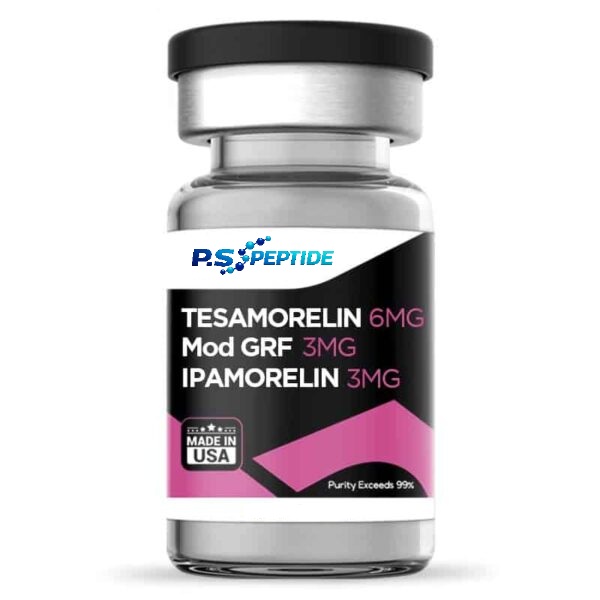
Tesamorelin & CJC-1295 (Mod GRF 1-29) & Ipamorelin Blend (12mg)
$115.00
Size: 12mg
Contents: Tesamorelin (6mg) & CJC-1295 (Mod GRF 1-29) (3mg) & Ipamorelin (3mg)
Form: Lyophilized powder
Purity: >99%
FREE Shipping on $200+ orders
| Title | Range | Discount |
|---|---|---|
| 10% Off | 3 - 6 | 10% |
| 15% Off | 7 + | 15% |
Description
Tesamorelin + CJC-1295 (Mod GRF 1-29) + Ipamorelin Peptide Blend
Advanced Growth Hormone Research Peptide Stack
The Tesamorelin, CJC-1295 (Mod GRF 1-29), and Ipamorelin peptide blend combines three well-known growth hormone research compounds into one advanced stack. Together, these synthetic peptides may support growth hormone (GH) synthesis and release through complementary mechanisms. Therefore, researchers often explore this blend when studying GH modulation, metabolic pathways, and tissue development.
What Is Tesamorelin?
Tesamorelin is a synthetic analogue of growth hormone–releasing hormone (GHRH). It may stimulate natural growth hormone production by binding to GHRH receptors in the pituitary and hypothalamus. Additionally, its modified structure improves stability and resistance to enzymatic breakdown.
For example, Tesamorelin contains protective terminal modifications that enhance molecular resilience. As a result, it remains active longer during research conditions. Consequently, scientists frequently study Tesamorelin for its potential role in GH secretion and IGF-1 signaling pathways.
What Is CJC-1295 (Mod GRF 1-29)?
CJC-1295 (Mod GRF 1-29) is a shortened and stabilized GHRH analog designed for prolonged activity. Unlike traditional GHRH fragments, this modified version resists enzymatic degradation. Therefore, it may maintain a longer functional half-life in controlled environments.
Moreover, CJC-1295 may bind to pituitary GHRH receptors and promote sustained GH release. Because of this, researchers often investigate its potential influence on protein synthesis, lean tissue development, and metabolic activity. In addition, structural substitutions may enhance binding stability and biological persistence.
What Is Ipamorelin?
Ipamorelin is a selective growth hormone secretagogue and ghrelin receptor agonist. It may stimulate GH release through growth hormone secretagogue (GHS) receptors located in the pituitary gland. However, unlike many GH secretagogues, Ipamorelin shows high specificity.
As a result, it attracts interest in studies focusing on targeted GH stimulation. Furthermore, its selective receptor activity makes it valuable for exploring hormonal signaling without broad endocrine disruption.
Chemical Makeup
Molecular Formula
-
Tesamorelin: C221H366N72O67S
-
CJC-1295 (Mod GRF 1-29): C152H252N44O42
-
Ipamorelin: C38H49N9O5
Molecular Weight
-
Tesamorelin: 5136 g/mol
-
CJC-1295 (Mod GRF 1-29): 3367.9 g/mol
-
Ipamorelin: 711.8 g/mol
Potential Pituitary Activity
This peptide blend may interact strongly with pituitary signaling pathways. First, Tesamorelin and CJC-1295 may activate GHRH receptors. Then, intracellular signaling cascades such as cAMP activation may follow. Consequently, these pathways could support growth hormone synthesis and release.
Meanwhile, Ipamorelin may activate ghrelin receptors on somatotroph cells. As a result, researchers explore its potential to trigger GH secretion with high specificity. Together, these interactions make the blend useful for studying endocrine communication and hormone regulation.
GI System Research Potential
Ipamorelin may also interact with ghrelin receptors in the gastrointestinal tract. Therefore, researchers study it for possible effects on gastric motility and intestinal signaling. Additionally, some models suggest it may influence gastric emptying and smooth muscle contractility.
Because of these findings, scientists continue exploring Ipamorelin in studies involving digestive physiology and tissue recovery models.
Synergistic Research Applications
The primary reason researchers combine these peptides lies in their complementary mechanisms. Tesamorelin and CJC-1295 may enhance GHRH signaling, while Ipamorelin may stimulate ghrelin pathways. Together, they may produce synergistic GH-related effects.
For instance, some investigations suggest Tesamorelin may influence muscle density and composition. Similarly, CJC-1295 has shown potential links to increased nocturnal GH signaling and lean mass changes in research models. Meanwhile, preliminary Ipamorelin studies suggest possible links to skeletal muscle development and IGF-related activity.
Although further research remains necessary, this blend continues to attract attention in advanced peptide studies. Consequently, many laboratories explore it for growth hormone axis research and metabolic investigations.
Tesamorelin & CJC-1295 (Mod GRF 1-29) & Ipamorelin blend is available for research and laboratory purposes only. Please review and adhere to our Terms and Conditions before ordering.
References:
- National Center for Biotechnology Information (2023). PubChem Compound Summary for CID 9831659, Ipamorelin. https://pubchem.ncbi.nlm.nih.gov/compound/Ipamorelin.
- National Center for Biotechnology Information (2023). PubChem Compound Summary for CID 56841945. https://pubchem.ncbi.nlm.nih.gov/compound/56841945.
- National Center for Biotechnology Information (2023). PubChem Compound Summary for CID 16137828, Tesamorelin. https://pubchem.ncbi.nlm.nih.gov/compound/Tesamorelin.
Reviews
There are no reviews yet.